TOM FRANCIS
REGRETS THIS ALREADY
Hello! I'm Tom. I'm a game designer, writer, and programmer on Gunpoint, Heat Signature, and Tactical Breach Wizards. Here's some more info on all the games I've worked on, here are the videos I make on YouTube, and here are two short stories I wrote for the Machine of Death collections.


Search
My ‘Enemies As Weapons’ Game Idea
The winners of the 48-hour game-making competition Ludum Dare were just announced. It’s a regular thing that awesome indie devs pile onto partly as a test of their skills, partly as a thought experiment, and partly just to jam and share ideas. The theme this time was Enemies as Weapons.
I didn’t enter, though lots of absolute beginners do, and it’s the sort of thing I love. But while I now feel capable of starting a small project like that, I don’t feel capable of finishing one in any kind of time. I was also pretty goddamn determined to get elevators working in Gunpoint by Monday, because four days on that is just kind of sad.
But I did have an idea for one. I think I like the competition’s theme because it’s suggests changing the state of enemies in a more interesting way than from alive to dead. Either to make them accidentally destroy things you want destroyed, as in games where you shove them into something or dodge their attacks, or to turn them to your side.
My game would be called Defect and Serve, and it’d be about bent cops. You’re a criminal who’s just been caught, unarmed, during an elaborate bank job. The arresting officer hints that he’d let you go for a hundred grand, and while he’d like to just take it from you, if you’re dead or caught there’ll be no explanation for the missing money.
Your only option is to pay up – tossing the money to him in bundles of $50,000 by clicking. Above his head is a meter labelled “Principles:” followed by two blue pips, and each bundle of cash makes one of them explode in a little shower of bills. When they’re both gone, he leaves and heads for the opposite end of the building.
It’s from a top-down view, and once that cop leaves you’re free to figure out a route to the exit avoiding the other roaming police. Each has a number of Principles pips, usually between 1 and 10. It’s possible to get out without running into anyone else, but if you do, you’re rooted to the spot and must chuck them a $50k bundle for each pip of Principles they have before you can go.
Once you’re out, the next levels are a series of heists where you start with limited funds, and make your way to vaults and safes to get more. Your objective is to steal more money than you spend bribing, obviously, so you avoid the very Principled cops like the plague.
A few levels in, you’re told you can also toss some extra cash to a cop after you’ve already turned him. This creates a red Loyalty pip, and if you give him as much Loyalty as he had Principles, you can order him to radio an all clear to the rest of the cops, making your current location safe for a while.
If you can double a cop’s Principles in Loyalty pips, you can actually click on another cop to order him killed. The turned cop will head for him, but won’t strike until the two of them are on their own. It’s up to you whether to distract or bribe the other guards to help him achieve that, or get on with sneaking through the building and hope he has the chance at some point.
Eventually you will encounter the odd White Knight cop, who’s impervious to bribes. If he’s guarding your objective, your only option is to have him killed. At this point cops with low principles become essential tools rather than minor threats, and you’ll actively try and run into one on his own so you can turn him to your side. Once you have, it’s worth intentionally alerting the White Knight to lure him away from colleagues, giving your turncoats the chance to take him out without getting caught.
I’m actually enjoying sticking with Gunpoint, it’s just impossible to resist coming up with a concept for a theme like that. I’ll probably have another Gunpoint progress report soon – I’m close to another milestone involving the AI, and I’ll be in a good position to figure out what kind of challenges are going to be fun in this frame work.
Even as it rapidly approaches an actual game, it seems to be getting further and further from the story-heavy finished article I had in mind when I started. I pictured it story-heavy because writing is trivial, but I’m starting to realise scripting is not. And it’s a low value type of work, only really good for one play through, and little to do with the medium’s strengths. I’m starting to wonder if there’s another type of content I can use to link a bunch of puzzles, or a more efficient way to convey story without visually depicting a lot of non-interactive events.
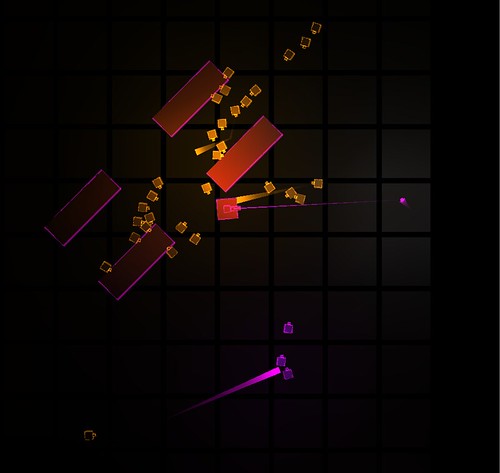 roBurky’s game, I think untitled, lets you convert enemies to your side or blow them up in a chain reaction.
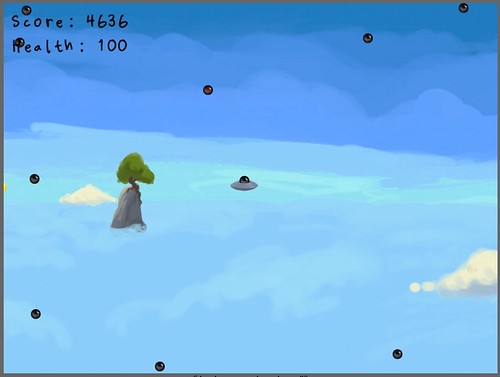 Alien Abduction of Aliens, a simple grab-and-throw game that’s beautifully drawn, and even more beautifully named.
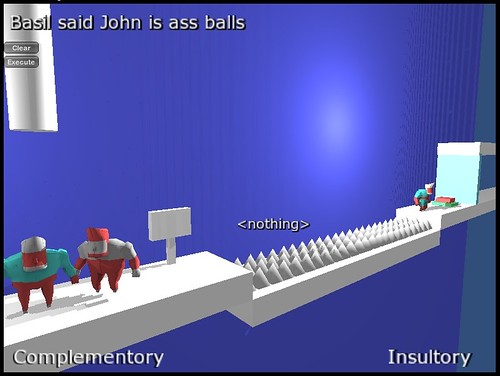 Sophie Houlden’s excellent Fib, in which saying “Basil said John is ass balls” is a valid puzzle solution. You lie to people to trick them into killing themselves, so that you can safely walk on their corpses.
 The end game of the competition’s winner, Fail Deadly. It’s a smart and immediately fun subversion of an RTS where you build both side’s bases in an attempt to keep them evenly matched long enough for nuclear war to break out, killing everyone.
More Game Jams