TOM FRANCIS
REGRETS THIS ALREADY
Hello! I'm Tom. I'm a game designer, writer, and programmer on Gunpoint, Heat Signature, and Tactical Breach Wizards. Here's some more info on all the games I've worked on, here are the videos I make on YouTube, and here are two short stories I wrote for the Machine of Death collections.


Search

15 Years of Indie Dev In 4 Bits of Advice
It’s rough in the games industry at the moment, and a lot of folks are spinning up their own thing. So I thought now might be a good time to boil down what feel like the key things I’ve learned in 15 years of running an indie games studio.
If you’re just arriving, we are Suspicious Developments. We did:
- Gunpoint (2013) – 10k reviews, 98% positive
- Heat Signature (2017) – 6k reviews, 94% positive
- Tactical Breach Wizards (2024) – 10k reviews, 98% positive
I’m the game designer and writer, I do some code, and until recently I ran the company (I now have help).
As you might be able to tell from the list, our games are all over the place in development time and genre. But they all sold great and reviewed great, and to the extent that we controlled that at all, I credit it to prioritising sustainability.
That means definining success not in total sales or accolades, but in how sure you can be of making another game at a happy, comfortable pace. All our games made more than twice their money back, and we’ve never been closer than 2 years to running out of funds.
The biggest factor in getting to that position, of course, was sheer luck: we made our first game in our spare time, with no budget, and it came out at the perfect time: 2013. Indie games had started to make real money on Steam, but the scene wasn’t flooded yet, so a small-scope thing from first timers had much easier time selling. That kickstart from zero to game-budget-money is ultimately why we’ve never needed a publisher.
So I’m not the right person to ask about startup funding. But we weren’t that rare in our first success, and we are increasingly rare in our still-being-here, still-making-stuff, still-independent. So I can at least advise on how to make what you have go as far as possible.
Looking back, this is what feels like the highest-impact, most-copyable aspects of that. I hope it can be of help.
Why four?
Look, I’ve only been at it 15 years. It’s gonna take me til 2030 to learn a fifth thing.
Contents
- Stay as small as you can
- Pick something prototypable
- Testing is the magic bullet
- Price is a solved problem
- A timeline, to illustrate
1. Stay as small as you can

I hate to say this at a time when it would sure be nice if there were more jobs, but I say it to encourage more stable jobs. Staffing up doesn’t really create jobs if it leads to layoffs or closure, and it fucks with a lot of lives along the way.
I think we only get to a healthier industry for workers when more studios are sustainable, and more jobs are stable. And things get unstable very fast as you grow.
The maths of how team size affects your chance of success is brutal:
- Success is making more money than you spent
- Doubling your team size doubles the amount of money you need to make
- But as the numbers go up, vanishingly fewer games make that much money. So it’s not just half the chance of success, it might be a tenth
For reference, Suspicious Developments’ average burn rate is about 3 full time salaries. I think if we had scaled up to 8 after Gunpoint, we would have made a bad game next, then no games at all.
Heat Signature was a tough game to figure out, and if we’d had less than 3.5 years of runway to test and iterate, we would have just had to release it in a bad state. If we’d had only 3.5 years of runway, I’d have been stressed as hell and the company would have collapsed if it wasn’t a hit.
We haven’t been consistent because all our ideas are golden, we’ve done it by staying small enough to keep testing and working until they’re good. And that’s a more sustainable kind of success, because rolling with punches is built in.
A lower burn rate is a superpower. There’s nothing else that’s fully within your control that can so dramatically increase your chances of success.
2. Pick something prototypable
 This didn’t really work, which was useful to know 6 years before launch.
By ‘prototype’ I mean a playable build that meaningfully shows what’s good about your game – a proof of concept.
A prototypable project is one where you can build that in an amount of time you can afford to lose. If you can make a prototype but it’s gonna take 3 years, it can’t serve the main purpose of a prototype: to check this game idea works while there’s still time to change tack.
Being able to do this quickly is crucial for two reasons:
1. If the prototype ends up proving your idea doesn’t work, or is beyond your means, you’re gonna want as much time as possible to do something about that.
2. If your prototype proves the idea can work, how much time you have left directly determines how good the game will actually be.
It’s also just incredibly motivating and clarifying for the whole team to be able to play the game they’re working on, and see where it’s headed.
So:
- Choose your project based heavily on which seems the easiest to prototype.
- Pick stuff you can prototype with the people you already have.
- Don’t obsess about anything until you have a prototype: you don’t know what’s important yet.
- Assume everything you do before you have a prototype might need to be scrapped or redone.
3. Testing is the magic bullet
 How did we make Wizards good? We asked players which bits were bad, then fixed them.
You are going to take an exam that costs all of your life savings to sit. If you ace this exam, you’ll win 2-10 times your life savings. The games-playing public already knows all the answers to the exam, and will tell you if you ask them.
It is incredible how many devs don’t ask them. Or don’t ask enough of them. Or don’t ask them early enough, or enough times.
Testing can be a fair bit of work and time, but nothing is as expensive as launching without it.
This phase of development is called ‘making the game good’, and if you don’t have time for it, that’s as big of a problem as it sounds.
4. Price is a solved problem

On a pretty real level, your sales are a function of:
- How many people arrive at your Steam page
- How much your Steam page makes them want to buy it
- How much it costs
The first one is famously hard. The second one heavily depends on making the game good, which you’re gonna spend 90% of your time on.
The third one is just a single number you can change in 30 seconds, and you can find out the correct value for it in one round of testing.
We just ask people how much they think the game should cost, and every time we’ve gone with the price most people chose, and every time they’ve sold great and reviewed great.
A timeline, to illustrate
I’m a visual thinker, so I laid all this out on a timeline. The positions are arbitrary, of course, but there’s no realistic place to put those five lines that doesn’t make doubling your headcount terrifying for your breathing room on both quality and stability.

Obviously most of this post is broadly aligned with conventional wisdom. But the thing I want to yell about, that people don’t seem to internalise enough, is how dramatically and reliably having more time, with a testable build, converts to your game being better and your studio being safer.
But does making a good game guarantee a hit?
Nope! But at the indie scale, making a bad one sure prevents it. And staying small helps again here: if you need to sell a million copies at launch, quality alone can’t ensure it – marketing and other factors all need to align. If you only need to sell 50k, you can get a lot closer to that with just good word of mouth.
Again, this is not a guide to selling the most copies. It’s a guide to making whatever funds, talent and good fortune you have go as far as possible, and keeping you better insulated from whatever bullshit happens next. And that comes down to giving yourself as much time as possible, and checking in with players to make sure you’re spending it well.
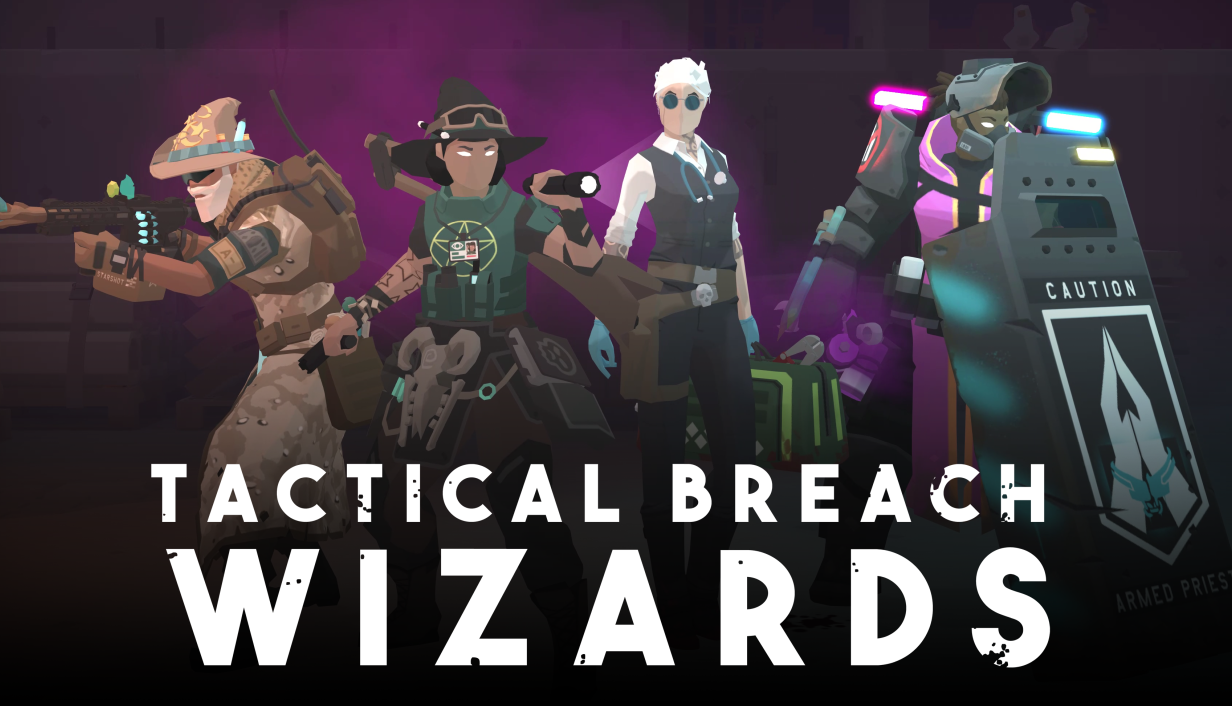
Tactical Breach Wizards Is Out!
Hi! Here’s the game we’ve been working on for 6.8 years!
You can see the launch trailer and all the details on the store page, but for some reason what I feel like sharing here is the very quickly knocked together trailer I made for the developer commentary, which comes with the Special Edition of the game. It just feels like the sort of thing long time blog followers might jibe with.
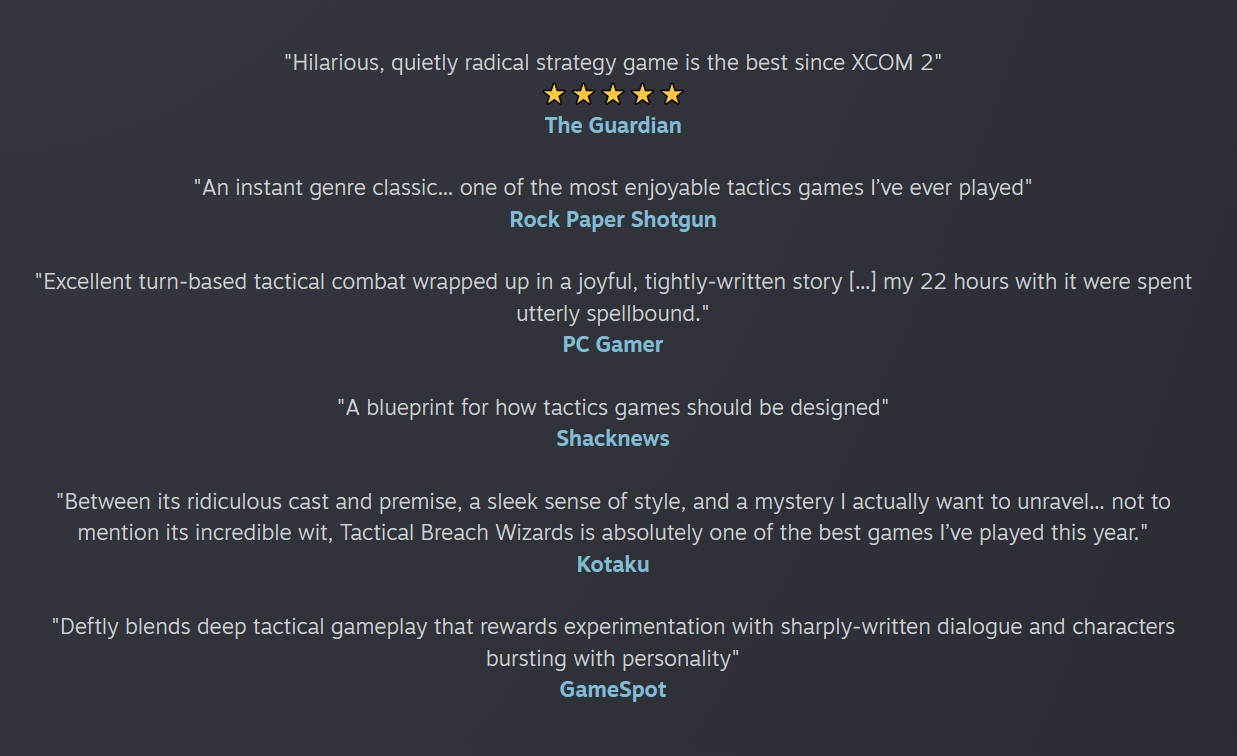
Oh, and I’m really proud of these quotes, so I’ll put them here for posterity!
A Snowy Ramble On What Makes Games ‘Different Every Time’
It’s snowing, and I have a mic that make me audible outdoors!
So I got mildly snowed on while I rambled about board games as roguelikes, what matters when making games ‘different every time’, and how Dune Imperium pulls it off so well.
Blundering Into Dead King’s Bluff
Blundered into a board game design lately, and it’s coming together. Here I am talking about it on a cold, sunny, noisy (sorry) day! Will show it in action once some little rules things solidify.
Unity’s Trap
Update: Unity have since walked back the worst part of this threat: those of us using older versions won’t be subject to the new terms unless we upgrade. As far as I understand, there aren’t new terms that would prevent them from pulling this same trick in future, but the fact that the outcry turned them around to this extent is a big relief for me. It suggests we at least have time to finish our current game, and do any essential patching, before they get desperate enough to try something like this again.
Unless there’s a legal guarantee of being able to stick with the terms that came with the version of Unity you use, though, this attempt at a scumbag pressure tactic leaves Unity a very risky prospect for future projects.
Original post:
Last week, Unity announced that they will soon start charging developers $0.20 each time their games are installed, past certain (high) thresholds. This came as a surprise to me and a few thousand other developers who chose Unity, invested in it, and paid for it in large part because they told us they wouldn’t take any of our revenue.
The reaction has been huge, but it’s not clear yet if Unity will make it right. The hasty, vague, conflicting clarifications they’ve offered all seemed aimed at reassuring people “No no, we’re not gonna steal much of your money, because you won’t be successful. Our plan is to steal that guy’s money.”
That’s not my issue, so I just wanna spell out exactly what my issue is. Continued
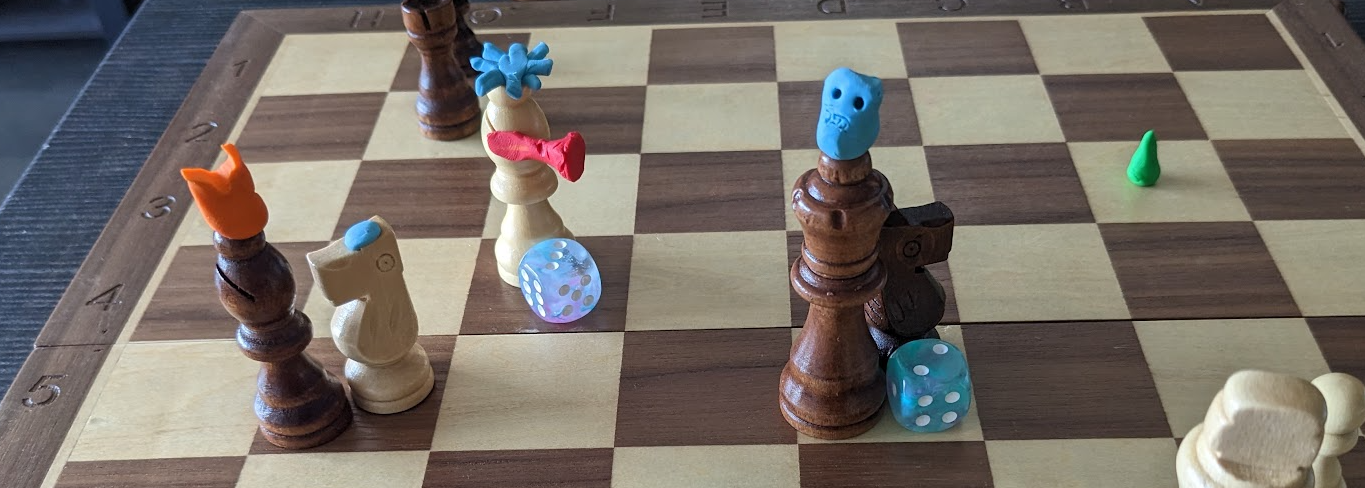
The Bone Queen And The Frost Bishop: Playtesting Scavenger Chess In Plasticine
My chess variant stalled a while, cos I rarely felt like coding when my work day was done. So I bought a chess set and some plasticine to try some ideas lo-fi style. What follows is how my first game of this iteration of Scavenger Chess played out.
Five Problems With Chess
Firstly, of course: many folks I like and respect love chess, and I’m happy for them and have no interest in persuading chess fans to like it less or want something different. But it’s not for everyone, and I’m one of the people for whom it’s not. So what I’m interested in is: what needs fixing to make it a game I enjoy? And if you did that, who else might enjoy it?
I am gonna call these problems problems, though, because it gets exhausting to say “possible areas where there’s scope to broaden or mutate its appeal to a different set of people, without wishing to detract from or disparage the great enjoyment many already draw from the game as it stands.” And because some of them, from my perspective, for players like me, with all the caveats above, seem incredibly fucking stupid. Continued
Badminton
Badminton is the best sport – and I’ve tried easily six of them. Here’s what’s good about it:
- Sound effects: hitting a shuttlecock (they call them birdies here) doesn’t just make a great sound, it makes a whole range of them. You’ve got your gentle pongs, your lively thwaps, all the way up to the fearsome splack of a good overhand smash. I’d say the only sport that can claim more satisfying noises is archery, and in badminton no-one has to die.
- It involves a lot less walking around and picking things up: this is the main thing it has over tennis – even a ridiculously overpowered shot never goes more than a couple feet from the court, and in tennis even the gentlest shot can bounce to a neighbouring country if you’re not there to stop it. This is because of a secret feature of badminton:
- It has Bullet Time built in: a shuttlecock is a weird little contradiction – streamlined in silhouette but engineered to slur through the air like it’s treacle. The harder you hit it, the faster it slows – meaning, basically, go ham. You pretty quickly learn to lunge for shots you think you’ve already missed, because the proportionate slowdown is so extreme that you sometimes get them anyway. It almost feels like you’ve gone slightly back in time to get another chance.
- Extreme dynamic range: these hard shots – aim them up and they absolutely soar, giving your opponent plenty of time to get in position, but also plenty of time to overthink it and whiff at the last minute. Aim them down and it’s the opposite: an absolute bullet to the ground, brutally difficult to defend, but when they do come back it’s such a sudden reversal that all you can do is flinch in self-defense. And those are just the hard shots – at the other end of the spectrum, there’s a whole artform in barely touching the birdie so that it lazily bellyflops over the net and dribbles down the other side in a fatal fall that leaves them hurling themselves across the court to reach it and attempt an equally pathetic shot back.
- Comedy: that’s very, very funny. Even more so as a return to a much more dramatic shot. And even more so if you’re busy celebrating your genius when the fucking thing comes back with exactly the same smug lethargy. And these are just the shots that work – badminton is a masterclass in the taste of victory turning to ashes in your mouth. Pride, cleverness, and an ostentatious wind-up come before a public self-own every three shots. Sometimes a long-awaited serve just drops to the floor without even touching a racket. Sometimes your sneaky side shot goes so far out it’s a valid shot in the next court. Sometimes they set you up for the perfect unstoppable smash and you just beast it directly into the net. Sometimes you beast it under the net. Sometimes you just beast it directly into the ground, and look around at everyone like, well I don’t know what that was supposed to be.
- It’s exercise but I enjoy it? This is sort of self-referential and redundant – I like badminton because I like badminton? – but the last point was too long-winded to feel like a conclusion so here we are.
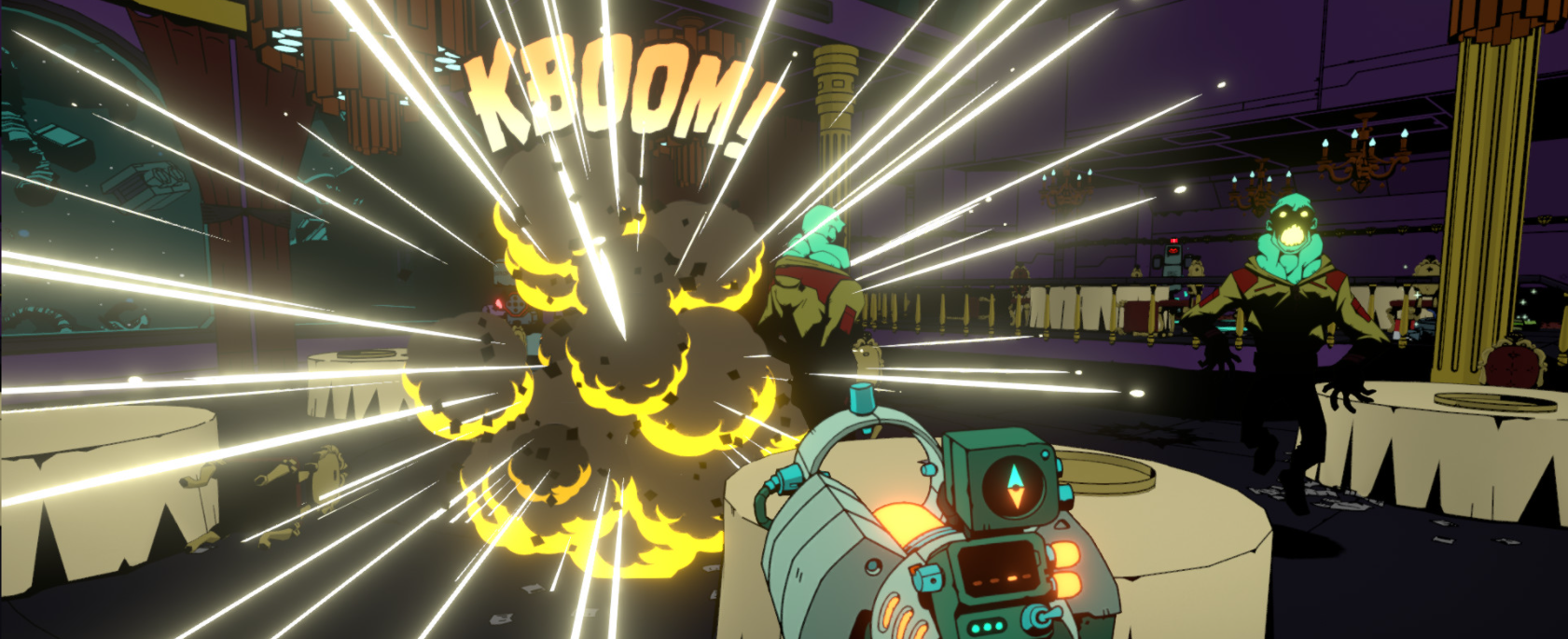
Void Bastards Vs Heat Signature: A Completely Objective Analysis
Note: this was written around the time Void Bastards was released, but languished in my Drafts for years because I’d planned to make it longer. What’s there all still makes sense to me though, so I’m just gonna make it about the 3 things I did cover and throw it out there:
Void Bastards is a roguelike first-person shooter about boarding randomly generated spaceships. I designed a top-down roguelike about boarding randomly generated spaceships, so it’s interesting to see how the two games tackled the same issues differently, and how well their solutions worked out! I picked three: Continued
Seeking A Composer For Tactical Breach Wizards
Update: Applications are now closed! It’ll take some time to go through them all.
Update: We’ll continue taking applications for the composer position until noon Pacific Time on Wednesday this week! This link should tell you when that is for you.
Original post:
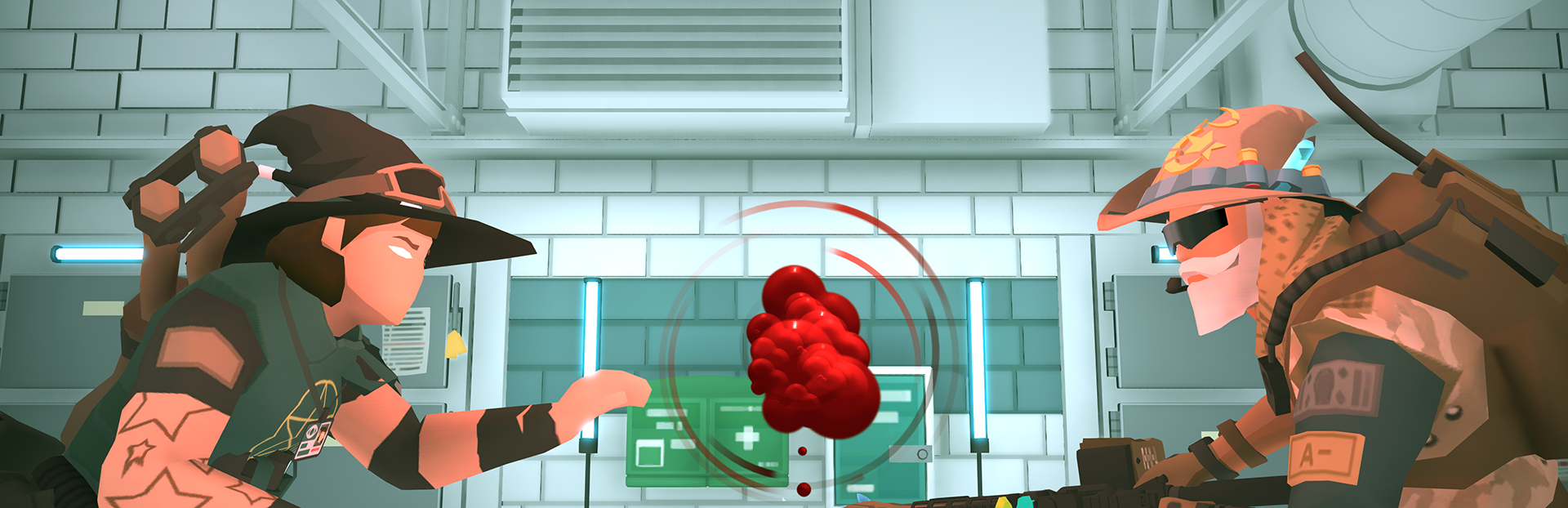
We’re looking for a composer to handle the music for Tactical Breach Wizards!
- This is a contract position for this project only.
- Remote, paid – let us know your preferred rate. Ask for what’s fair, getting this done cheaply is not a priority for us.
- See below for the scope and nature of the work.
- We expect to be working on the game for at least 1 more year, so that’s the rough time frame for working on this.
We don’t care about years of experience or prestige of prior projects, all we need is to hear some of your existing work – whether it’s personal or professional. You don’t need to have worked in games before – the game-specific concerns are outlined here so you can judge if they’re gonna be a problem.
Instructions for applying are at the bottom of this post, but first I’ll give as much info as I can about the job: Continued
Gridcannon: A Single Player Game With Regular Playing Cards
I thought it would be an interesting game design challenge to come up with a single player game you can play with a regular deck of playing cards. My first try, about a month ago, didn’t work. But on Sunday I had a new idea, and with one tweak from me and another from my friend Chris Thursten, it’s playing pretty well now! In the video I both explain it and play a full game. I’ll write the rules here, but they’ll make more sense when you see it played: Continued
Making A Better Card Feel Worse With UX
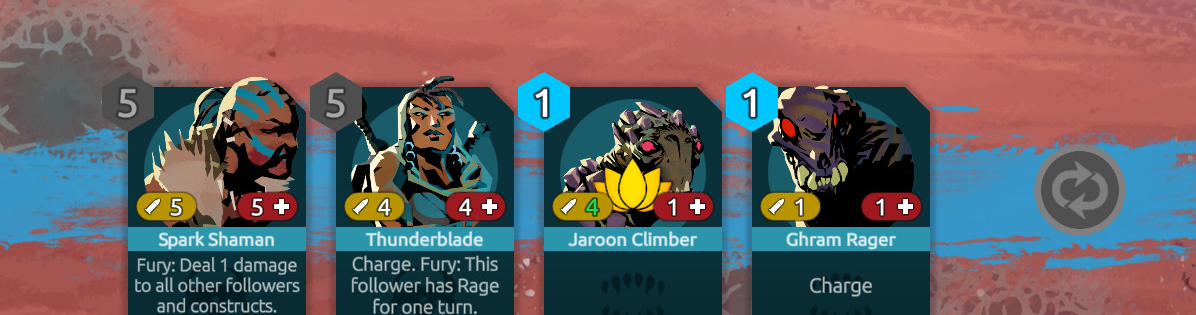
Nowhere Prophet has a power where each turn you can choose 1 card from your hand to discard, and draw another to replace it.
Slay the Spire has a power where you draw 1 extra card per turn, then must discard 1 of your choice right after.
Slay’s power is straight up better: you get to see what the new card is before deciding what to discard, which both lets you factor it into synergy considerations, and allows you to discard the new card itself, if it’s worse than what you have.
But experientially, Nowhere Prophet’s feels more positive. You’re presented with a hand you can keep, or if you like you can get a do-over on the card you like least. Doing nothing is fine, but if you see a bad card you can chuck it for good odds of a better one. Yay! Continued
Steam Quirks For Developers
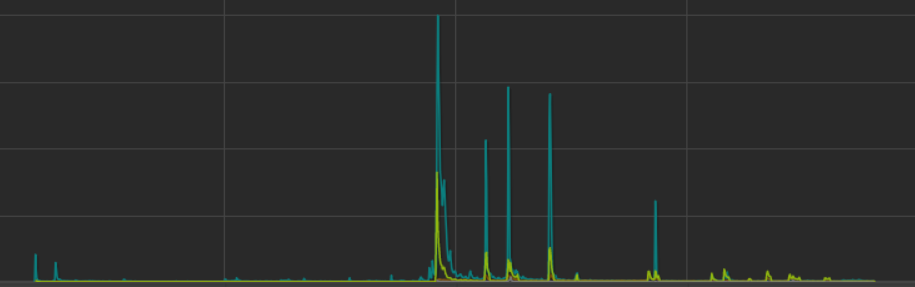
Talking to people at GDC and Rezzed, especially people just starting in game dev, made me realise I’ve accumulated a load of non-obvious knowledge about how Steam works and how best to use it. Info like this tends to get passed around between established devs, at events and in closed circles, but newer devs and those excluded from these groups don’t get access to it.
Everything marked ‘info’ was either learned by me first hand, or told to me by Valve at events with the express purpose of getting this kind of info out to developers, without request of confidentiality. I say this because I do also get told things confidentially – none of that is in here. Continued
Heat Signature’s Space Birthday Update Is Live!
Heat Signature is one Space Year old today! To celebrate, we’ve released a big free update we’ve been working on for five months, with over 20 features – including our own twist on a Daily Challenge.
Click through for details on each:
Pitch: Tactical Breach Wizards
I’ve been tweeting GIFs of a game I’m prototyping in Unity for a while now, codenamed Tiny Ex-Cons, and recently did a video blog about the core elements I’m hoping to combine if I go ahead with it.
It’s too early to know if this is my next big project or not – my prototype doesn’t have enough to prove the concept yet – but I do want to start showing more of it. And I’ve been holding back part of the concept, and indeed the name. It’s not hard to describe, but it’ll only really work with the right art, so I didn’t want to talk about it until I was sure that side of things would work.
And hey, you know who’s good at art? Gunpoint and Heat Signature artist John Roberts! So he’s joined me again and sketched out some ideas for this new concept. Which is… Continued