TOM FRANCIS
REGRETS THIS ALREADY
Hello! I'm Tom. I'm a game designer, writer, and programmer on Gunpoint, Heat Signature, and Tactical Breach Wizards. Here's some more info on all the games I've worked on, here are the videos I make on YouTube, and here are two short stories I wrote for the Machine of Death collections.


Search
Gunpoint Art Style Mockup
Edit: This isn’t new, just separating it out from this so it can live on the new Gunpoint site.
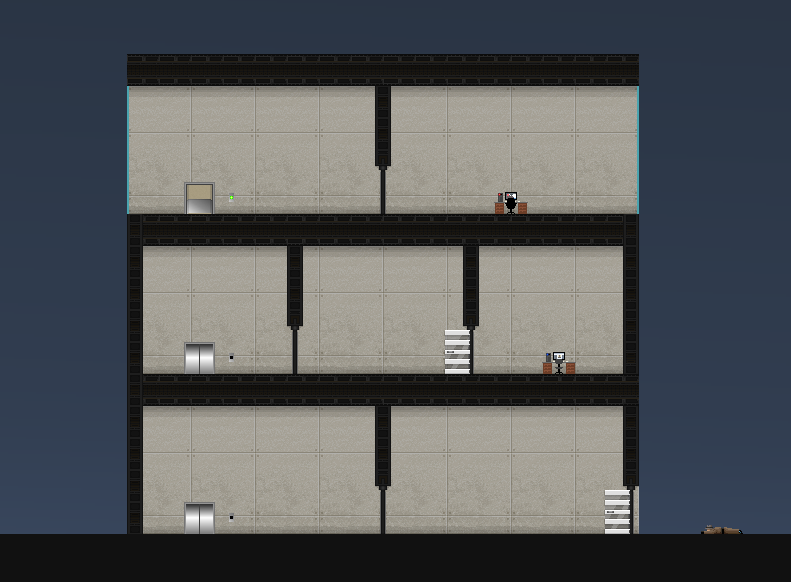
Gunpoint’s at a really exciting stage now – character animation for the player and the basic guard type is done, so the game has a lot of its final ‘feel’. And John’s just passed over the first set of environment art, along with a mockup showing all of it crammed into one showcase level – a real one would be less busy. And check it the hell out (click):
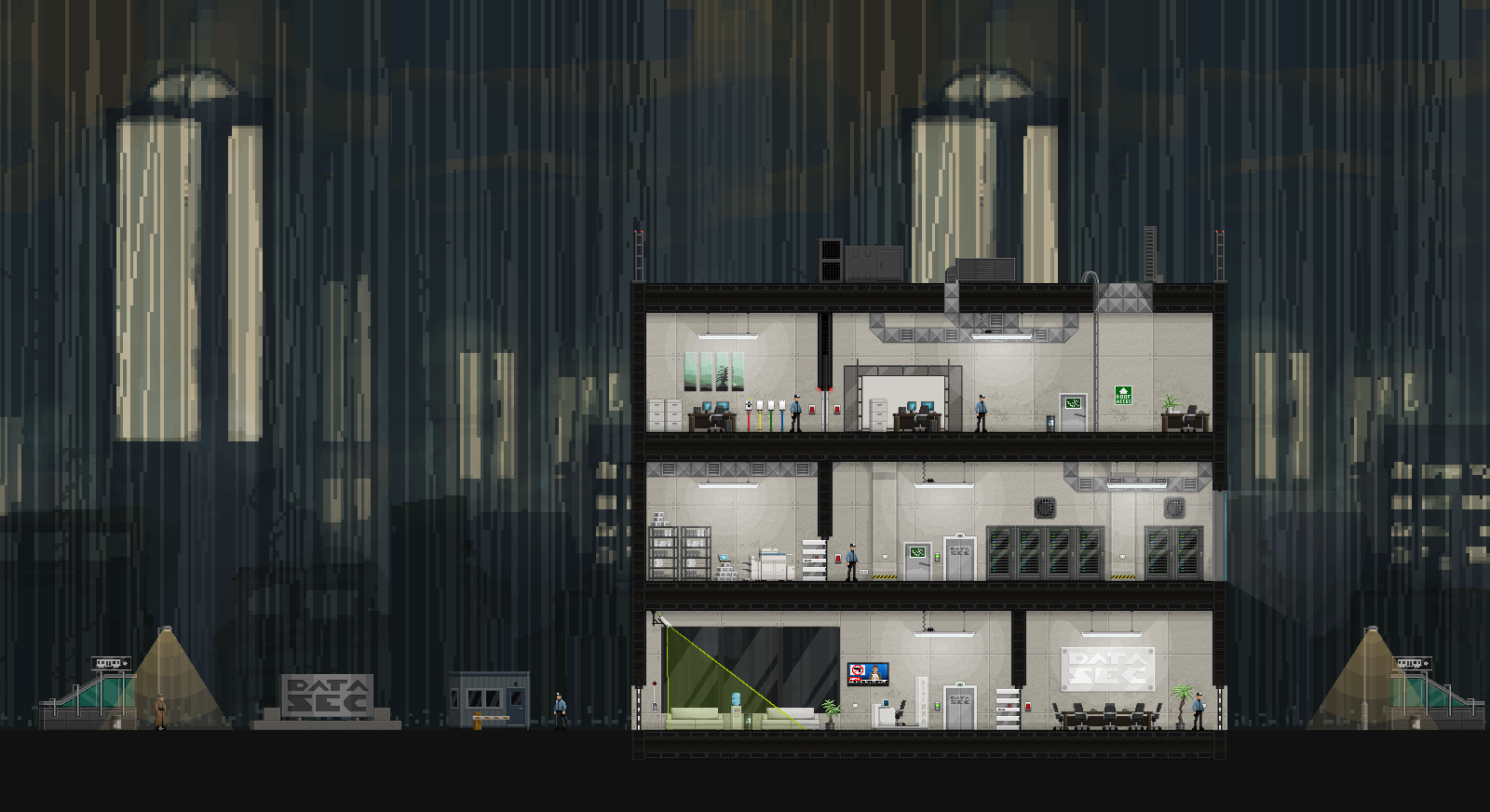
It looks way too good. Now I feel like I’ve got to make a proper game or something. The background is obviously just a stretched version of Fabian’s original at the moment, but the rest just looks done. Which means I’m way behind on the coding side of things.
So by the end of this weekend, I want to have all of Gunpoint’s Act One working: that’s the first for or five levels, which mostly use this tile set. It’s sort of about escape anyway, come to think of it. By the end of them, the player should understand all the basic mechanics and have played around with crosslinking a bit – enough to see the point of it.
It’ll also kick off the plot, and resolve the most immediate part of it, but how much of that will work at this stage I don’t know. I’ll certainly get the actual dialogue in there – so far, writing has been the easy bit.
Gunpoint Art Progress
Got three levels done and the bare bones of the environment art for this setting in. It’s pretty far off the lovely mock-up right now, but already it feels awesome to be working with stuff that looks good. I’ve never built anything that didn’t look like a programmer’s prototype before.
Gunpoint And The Other Game
I had an idea for another game, recently. It’s an RTS that would solve a lot of my main frustrations with RTSs, with a few fairly simple mechanics. And it’s an idea that keeps spawning other, smaller ideas, and suggesting parts of itself I might like to cut out to make it even simpler and better.
It’s gamey in a way that Gunpoint isn’t, in that it’s really just a few basic systems: no context, story or even content would be necessary for it to work on a basic level. And it might actually appeal to people outside of my skull, in a way that Gunpoint probably won’t. No logic or thought went into my choice of a jumpy platformer about a private detective for my first game, it was just the first idea that interested me. The RTS feels like something worth making, and something that someone else will probably make if I don’t.
In other words, everything’s been telling me to just stop making Gunpoint, learn Unity, and switch to this newer, better, more potentially successful idea.

I’m not going to. Abandoning an old idea doesn’t solve the problem of forever having newer, better ideas. They’re always going to come faster than you can make them, and for a while, they’re always going to make your old ones seem less exciting. Whatever you do in response to that is what you’re always going to do, so if I ditch Gunpoint to make this RTS, I’d ditch the RTS to make the RPG idea I’m inevitably going to have in six week’s time.
But going back to Gunpoint is harder now. Not because it’s an unexciting idea – the thing at the heart of Gunpoint, which I haven’t really talked about yet, still gets me totally fired up. But looking at it after this gleamingly simple, efficient new idea, it looked incredibly flabby, unfocused, and most of all daunting. I just don’t know how I’m going to do half this stuff, and some of it doesn’t seem very connected to what I’ve done so far.
I’ve tried to simplify Gunpoint lots of times, but I’ve never really questioned that it was going to be story-driven. It couldn’t just be missions, it had to be punctuated with scripted sequences, major characters and predetermined developments.
But that wasn’t really a design choice. I just automatically included it because I’d already written a bunch of scenes, dialogue and characters to flesh out the world in my head. It’s instinctive to write that kind of stuff when you’re thinking up a new world, and useful too. But I should have taken an extra step back and thought, “OK, why do I need to tell these stories to the player? And how much work is it going to be?”
 I don’t have any new screenshots to show you. Here are some horses.
Now that I take a more squinty-eyed look at the roadmap ahead, I start to see just how much coding each one of these things is, and how little it adds to the game as a game. Making non-interactive scenes on top of your interactive ones is like making a second game – a shitty game no-one can play. And I know from editing GTA IV movies that I’m an obsessively redactive director: I’d never quite be happy with the way they played out.
So I’m scrapping all the non-interactive stuff. There’ll still be story context for each mission, but it’ll be the text of the briefing you choose from some kind of job listings site, and text message conversations with the client.
Oddly, since restricting myself to this for practical reasons, I’ve found it also makes more story sense: you’re a private agent specialising in illegal activities, so you probably would get your jobs from an anonymous site rather than walk-in clients, and communicate by text rather than in person.
It was an easy choice to make – I don’t have to delete anything, because the stuff I’m scrapping is stuff I haven’t made yet. I probably would have given up on a lot of it when I did come to build it. But what the other game has helped me do is clear it out now, while I’m working on the cool stuff. I had to make Gunpoint a more appealing thing to work on, and that meant cutting reams of big wibbly translucent flab until I could see the route to completing it. It clears the head, brings the game into focus, and makes it feel achievable.
 Shrug.
I’m always asking developers what they’ve learned from previous games, and sometimes they draw a blank. So I might start ending my Gunpoint diaries with a summary of what I’ve finally figured out.
Writers shouldn’t write games. Designers should give them a little box to write in, and they should write in that. I left my writer hat on way too long after coming up with a vague idea for the world of Gunpoint, and started writing the actual game. “This happens, then this happens, then you get this item-” Shut up! Games aren’t just first person movies, Tom. Design a thing that is fun, then write whatever story context that design needs.
‘Hard to do’ and ‘easy to do’ are irrelevant, ‘good value’ and ‘bad value’ are what matters. I say the story stuff was going to be hard to implement – it wouldn’t be, really. Not as hard as the central mechanic I’ve yet to start on. The difference is, if the central mechanic works, it’ll lead to dozens or even hundreds of fun interactions for each player. The story stuff would be fun a maximum of one time per player, likely not even that. It’s phenomenally bad value. If you’re Valve, and there’s some reason you really want to push this stuff, you can afford that. But if you’re one guy with no experience making games, you can’t.
Unrelatedly: Machine of Death day is in about eight hours. I’ve put together a post about how you can get it, what the postage will cost, and what other forms it’s going to be available in. That’ll go up once it’s officially MOD-Day.
GTA IV Shorts: Cut Off
GTA IV Shorts
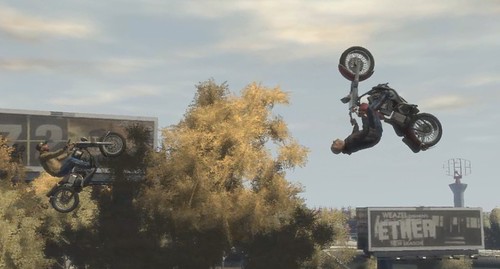
Split Up (YouTube HD)
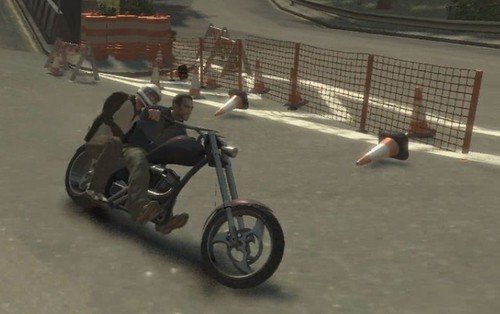 Positive Mental Attitude (YouTube HD)

Original post:
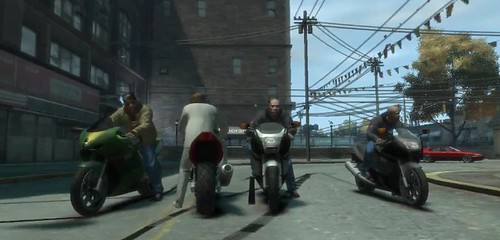
As I guess you know if you follow me or @PC_Gamer on Twitter, I’ve put up the- what, third? GTA IV short made from our various antics. This one has the best beginning, and the best ending, of mine. The middle is meandering glitchy madness to tie the two together. The high-def version is on YouTube – there’s a sentence that would have sounded strange a year ago.
Most of the popular ones on Rockstar Social Club are multiminute stuntwank epics nailed together from several clips of footage – mine are all single clips, simply because cuts are a pain in the jerk to jerk around with. I have – eep – 33 of these bastards I’ve edited, and I’m going to be hurling up one a day this week, unless I, like, don’t. I’ll update this post with links.
Grosse Pointe Blank
Genre: uh… romantic hitman comedy?
Stars: John Cusack, Minnie Driver, Dan Ackroyd, Jeremy Piven, Michael Cudlitz, Alan Arkin (Catch 22), Joan Cusack, Hank Azaria.
Plot: a hitman is hired to do a job in his hometown at the time of his ten year high-school reunion, and on the advice of his psychiatrist decides to attend and try to reconcile with the girlfriend he abandoned for a decade without a word, and maybe not kill anyone for a while.
Why It’s Great:
- John Cusack.
- Both the electronic score by Joe Strummer and the all-eighties soundtrack are fantastic in their own rights, -and- brilliantly used. I Can See Clearly Now makes the opening credits and first scene unforgettably cool, and later on Mirror In The Bathroom accompanies a fight scene brilliantly.
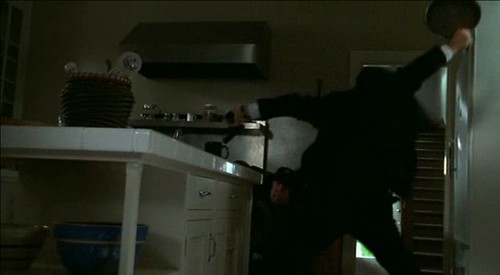
- Assassination is inescapably appealing, and several of the gunfights are great – especially the final one, which features a frying pan.
- You’ll notice a second Cusack in the cast listing – there are actually four Cusacks in it altogether. I haven’t worked out who Bill is yet, and Ann’s appearence is very brief, but Joan is brilliant. She often plays significant roles in John’s films – even playing his character’s sister in Say Anything – and no-one cries nepotism because she’s really, really good.
- Jeremy Piven is always great, but this is his best character ever. I know you haven’t heard of him, but he was in the horrible Very Bad Things, and you’d probably recognise him if he was pointed out to you. Some of his quotes aren’t the best on paper, but when he says them, the “Ten years!” and “I was looking for a little validation on my life, but I guess I came up short” lines are some of the best in the film, and it’s a film of great lines.
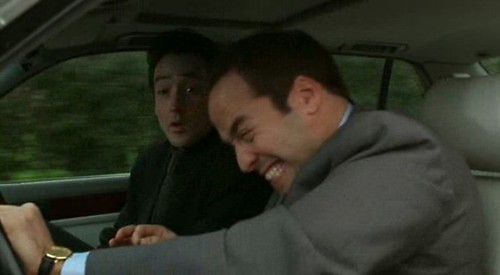
Quotes:
Waitress: What would you like in your omlette?

Blank: Nothing in the omlette, nothing at all.

Waitress: Technically that's not an omlette.

Blank: Look, I don't want a semantic argument about it, I just want the protein.
Grocer: Easy there, chief. I don't see hollow-point wound care on the menu.
Paul: I'll see you at the 'I've-Peaked-and-I'm-Kidding-Myself' party.
Blank: Debi's house.

Paul: Kinda crept up on you, didn't it?

Blank: No, you drove us here.

Paul: ... Yep.
Clips: school.avi (2MB)
Gridcannon: A Single Player Game With Regular Playing Cards
I thought it would be an interesting game design challenge to come up with a single player game you can play with a regular deck of playing cards. My first try, about a month ago, didn’t work. But on Sunday I had a new idea, and with one tweak from me and another from my friend Chris Thursten, it’s playing pretty well now! In the video I both explain it and play a full game. I’ll write the rules here, but they’ll make more sense when you see it played: Continued
Great Moments In Television, 2016
These are all suspiciously recent so this is probably only the best three moments of the last few months, but that does at least mean I could get clips. Until they’re taken down. I put them on Streamable in the hope they’ll stay up longer, which has the side-effect that they loop when they’re done. Shrug emojii.
These are not spoilery except for The Crown, in which nothing really happens. Continued
Google+ Is The Exact Opposite Of The Social Network We Need
Or: I’m Completely Misunderstanding Google+
The main part of Google+ is a social updates feed like Facebook or Twitter. With Facebook, you have to confirm someone as your friend before they see your updates. With Twitter, anyone can see your updates without asking permission, unless you make a special ‘locked’ account. With Google+… Christ. Continued
Google Oozes Connectivity
Google are always doing interesting things, and one of the reasons I get excited about our current era is that a company distinguishing themselves by not being evil do so well. In fact, they’re the defining architects of the internet itself, and the internet is a big enough deal that history will look upon the computer itself as a footnote to the revolution it enabled. Google are the largest part of a change that isn’t merely technological, cultural, societal or domestic – it’s a milestone in the evolution of the species. There’s ‘can use tools’, ‘brain has well-developed speech centre’ then ‘Googles’.
The new thing is that they’re giving free wireless internet access to the whole of San Francisco. If they move into banking, expect them to drop free money from planes.
It’s hard for me not to imagine a huge translucent blob of connectivity enveloping the city now. There is something wildly futuristic about the idea of free wireless access everywhere – didn’t dialling up, paying per month and plugging things in always feel a little archaic? But more than that, the scary and exciting thing to me is that the internet itself now has an enormous, incredibly rich and powerful agent in the physical world. Google just want the internet everywhere, so much so that they’ll bring it about at their own expense. Until now it’s been a force of nature, growing according to a mess of conflicting interests of parties fighting it out, using the net as a battleground. Now its growth is going to be directed and encouraged by an apparently benevolent corporate super-power. It has become a thing trying to take us over, rather than one waiting for us to realise we want it.
Maybe the story sounds more trivial than that, but to me there is something huge about the idea of giving a free connection to everyone in a city. Not a voucher to have one installed, just free connectivity hanging in the air itself, waiting to be picked up by a wireless network card. Suddenly that city is super-connected – the barrier to being online in a serious way having plummeted from an expensive subscription and installation to a simple $20 component – and the implications of that could be vast. It doesn’t take a visionary to see the city-wide radius increasing, or at least being copied elsewhere, and in the very long term it could actually accentuate the developed/developing country divide – education, information skills and even which parts of the brain and body are more developed are going to get more and more significantly different between super-connected countries and offline ones. It’s the stuff of sci-fi, but in fiction this kind of schism has always been characterised as dystopian. Reality looks more positive, however ugly that divide might get, it’s sharper for one side being raised, not the other lowered.
Good Story In Games
Sounds like I’m going to preach at you, but actually I want your opinion: which games have good stories, and why do they work?
I’m asking because I’m in the early stages of writing stuff for Gunpoint, but I’m also interested in general. I’m incredibly impatient with stories that don’t engage me right away: Dragon Age 2 is dead to me, just because it introduced too many people I didn’t care about and didn’t make them do anything interesting in the first hour or so. The other eighty hours of the game might as well not exist.
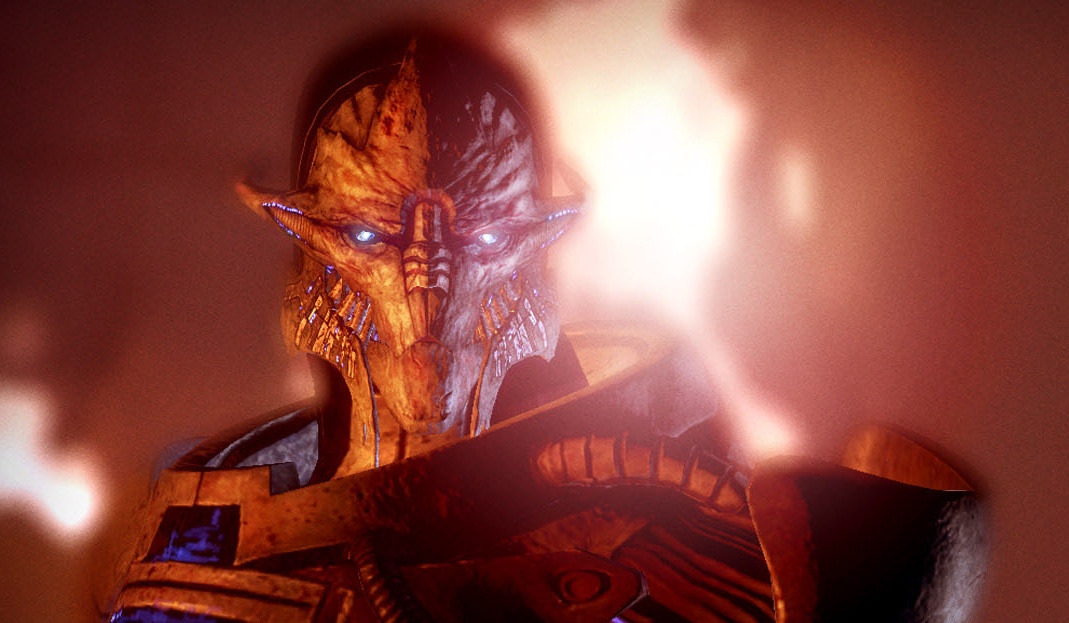 Cared.
Mass Effect, on the other hand, is my gold standard: I saw Saren’s betrayal in the first mission (even though my character didn’t), and it was genuinely maddening that he got away with it.
The rest of the game isn’t even that well written – I didn’t really understand why I needed the Thorian or Benezia or Liara or the vision or what the Conduit was until I read the wiki afterwards, but it didn’t matter because the Saren thread hooked me so early.
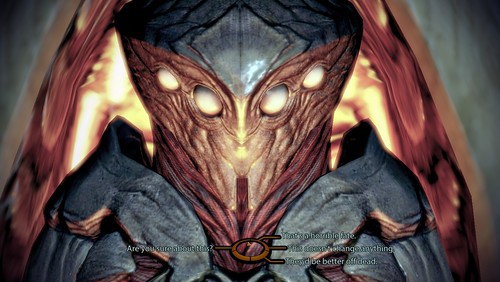 Did not care.
What’s yours? I’m interested in games that hooked you quickly, immediately made you want to know what happens next, and why you think they worked. I’m also interested in characters you immediately liked, hated or just cared about on any level.
Most games can do that if you’re willing to read or listen to 3,000 words of dialogue, so really I’m interested in the ones that didn’t take ten hours of investment to make you give a shit. CoughJadeEmpire.
If the answer’s Portal 2, by the way, it would be nice if you could avoid spoilers. Cheers!
Gollum Beat Box Like You Never Seen
|
Yo my name is Gimli and I’m a fucking dwarf Now all you Boffins and Bolgers, Bracegirdles and Proudfeet Yo, I’m harder than a Mithril coat |
GHGC Dev Log 4: Rules Of Retraction
I’ve finally found the right blend of Unity’s built-in physics and my own custom equations to make the rope in my grappling-hook-game prototype feel strong, reliable and satisfying to use. I also added a lamp post and made some things blue.
If you want to hear about future updates, I’ll always post them on my Twitter.
GHGC Dev Log 3: Grappling With Hooks
Yep, it’s got a grappling hook!
I have something in particular I want to do with grappling hooks that I’m not ready to talk about yet. But grappling hooking around is also part of a set of interactions that I hope are going to just feel really nice – to some extent this game would be about the pleasure of execution.
This is just a quick demo of how it’s working right now – shoddily, but well enough to give me an idea of how to refine it. I’m pretty pleased to have got this far in three days, despite still really struggling with some Unity stuff. Continued