TOM FRANCIS
REGRETS THIS ALREADY
Hello! I'm Tom. I'm a game designer, writer, and programmer on Gunpoint, Heat Signature, and Tactical Breach Wizards. Here's some more info on all the games I've worked on, here are the videos I make on YouTube, and here are two short stories I wrote for the Machine of Death collections.


Search
What’s Wrong With Team Fortress 2’s Unlocks
I cooed a little about the amount of free stuff Valve have added to TF2 since release, but it’s not purely to fix or improve the classes. They’ve been experimenting with ways to leverage this free content to add an element of persistent progress and character customisation to TF2. But their experiments have been weird, and so far the resulting system doesn’t really do its job. If you’re all too familiar with why the current system needs changing, you can just skip to how I suggest changing it. Here’s what’s wrong:
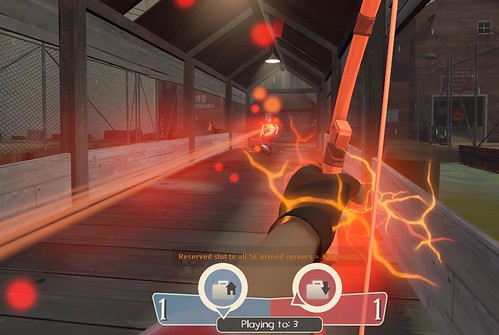
You can unlock weapons for a class by earning its achievements. That means everyone plays the same class when its new weapons are released, even before they’ve earned any of them. We’re bribed to play that class at the very time when TF2’s primary problem is inevitably going to be too many people playing that class. And we’re often bribed to play it in counter-productive ways to fulfill achievement criteria, some of which are just fun little jokes.
You can ‘find’ weapons and hats randomly. On the plus side, that sometimes gives you a weapon for a class you don’t normally play, encouraging you to try it out. On the down side, well:
- A lot of what you find is duplicates of what you already have, which means that little gold message comes to be associated more with disappointment and absurdity than excitement or pleasure.
- People’s fortunes vary wildly without any correlation to skill. Some people play for hours a night, rarely get a weapon, find only dupes, and have never seen a hat in hundreds of hours of play. Others consistently get unlocks every half hour or so, and have copious hats for classes they don’t even play.
- Consequently, very rare and exclusive class items like hats don’t signify anything when you see a player wearing them. What does the mighty Camera Beard tell you about a Spy? Nothing, he just got lucky.
You can ‘craft’ items by combining lots you have to produce one you might not. Presumably meant to tackle the dupes problem with the random drops, but what we understand of the current system is totally bizarre. If you don’t have the Eyelander, you seem to need six copies of the other two Demoman weapons, plus at least eight melee weapons, to craft one without losing anything you need. In a given time period, you’re about 13.8 billion times more likely to just find an Eyelander than what you need to make one.
For a hat, you’d have to find eighty-one weapons you don’t need just to make a random one. To have more than a 3.4% chance of crafting the one you want, it takes a hundred and twelve. At the end of which, you’ve got something a new player might find in his first hour with the game.

That’s what’s wrong with the current system. I think it needs a few changes to work as an addictive RPG, as a way of customising your characters to your tastes, and as a way of showing off your skill or dedication in the way you dress. The unlocks system ought to make the repetitive violence feel like part of a larger goal, and give you a sense of progress even if you lose. Here’s how I’d do it:
Unlockable Weapons: You’d be able to browse these from the main menu to see what’s available, and select one you want to unlock. Each requires somewhere between 250 and 500 points, and once you select it all the points you score in-game, as any class, count towards that. That’s about 2-4 hours play – the Flare Gun might be 250, the Direct Hit 500. You need to be in a game with at least four non-idle players or bots for your points to count, but beyond that anti-exploit measures are probably futile.
On top of that, every five hours or so you’ll get a random weapon unlock that you don’t already have. If it’s the one you’re working towards, points earned so far transfer to what you pick next.
The idea: Every match gets you closer to something you really want, and the items you choose first make you a different player to those around you. At the same time, you can still get something unexpected for a class you don’t normally play that might encourage you to try them.
Achievements: I think they should stay – I even think the silly ones should stay. In fact, I’d get rid of the sensible ones, and just leave the ridiculous accomplishments – taunt kills, ironic deaths, corpse dancing and tortured puns (Slammy Slayvis Woundya? That’s what you’re going with?). But they no longer earn you weapons, they’re just an acknowledgement for any time you do something remarkable.
The idea: Silliness absolutely has a place in TF2, and trying to get things like taunt kill achievements just makes the game hilarious for you and your enemies. But no-one should be bribed to go for them if they don’t want to.
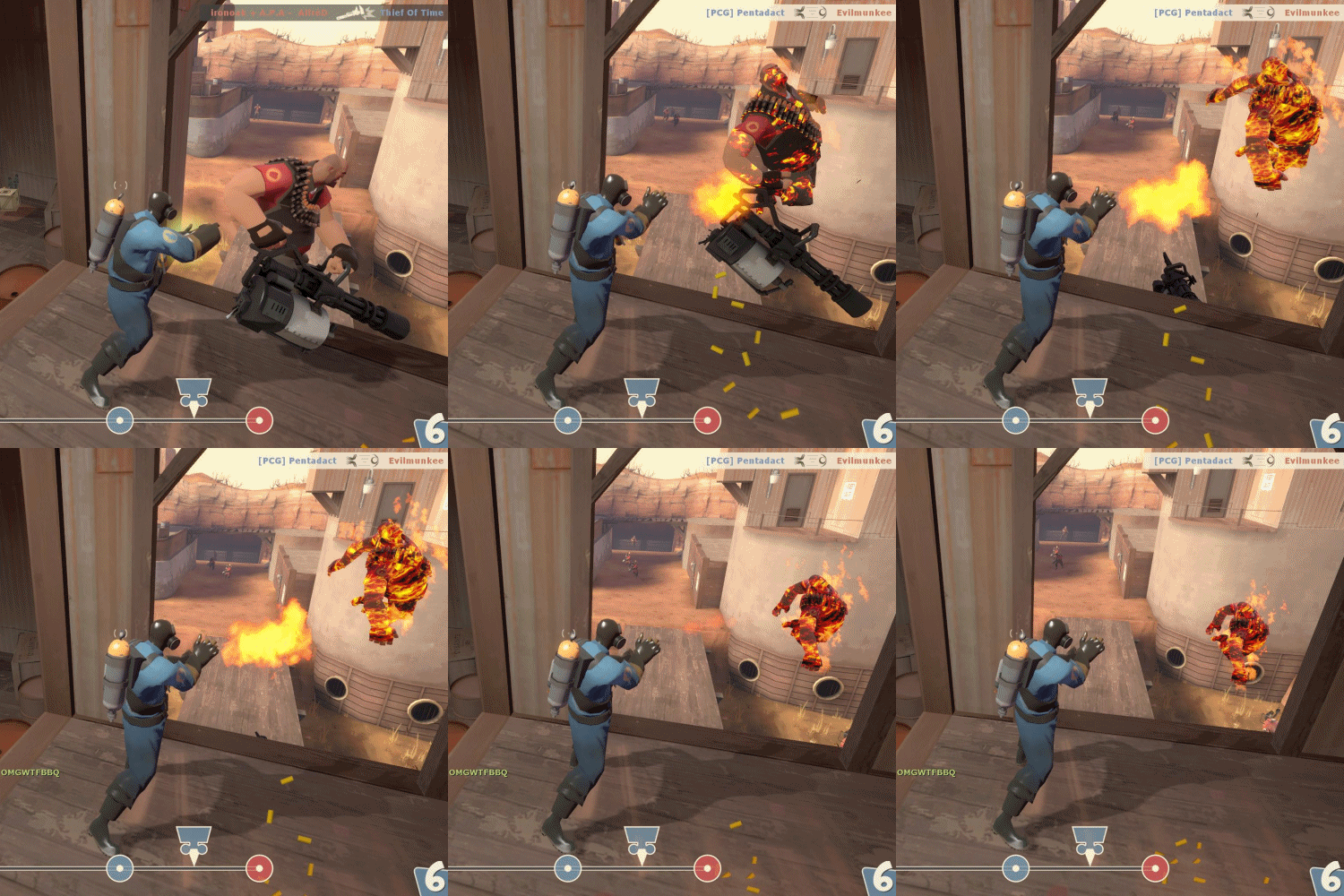
Feats: This is where the sensible achievements would go. They’re things that genuinely benefit your team, so you’re rewarded each time you do them: some bonus points towards your unlock (but not your in-game score) and a little pop-up: “Medic Feat! Extinguished five team-mates, +2 points”. Things like multi-kills, capturing a point alone, setting light to a cloaked Spy, killing a fully charged Medic, or making the winning capture would always be rewarded.
The idea: By letting people know they’ll be rewarded every time they do this, it both teaches and incentivises intelligent play. Achievements already do this a little, but not reliably: plenty of the actions they suggest are actually pretty dumb.
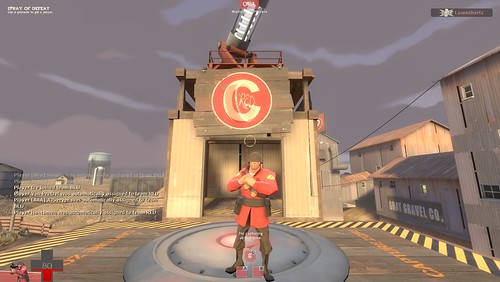
Unlockable Hats: These are handled separately, but again you choose which you want to unlock. When you do, only points and feats earned as that specific class count towards it, and the number required is in the thousands – twenty hours’ play for most, more for some special prestige items. You still earn points towards your weapon unlock at the same time.
The idea: A hat says “I play this class, I play it well and I play it a lot”. A Camera Beard says “I am amazing or crazy.”
Crafting: No crafting. I don’t think the system is entirely unsalvagable, and Chris Livingston does a good job of salvaging it in a much shorter post than mine. But ultimately any full crafting system hinges on finding dupes, which I think ruins the “ooh, I found something!” moment by diluting it with disappointment.
![[FBP] Dirty Squirrel is looking good!_0002](http://farm5.static.flickr.com/4052/4207772952_4a98696b4d.jpg)
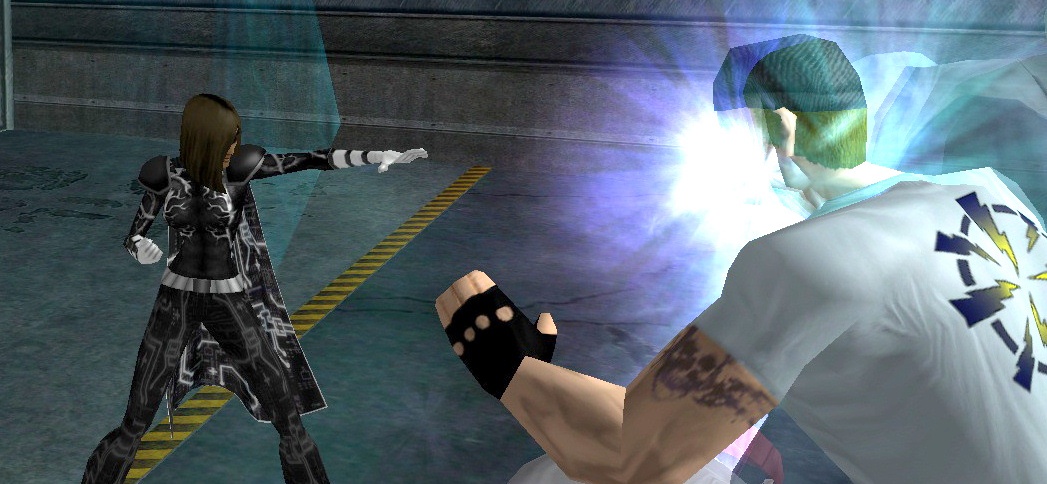
A Different Way To Level Up
Levelling up is pretty much the heart of RPGs, because it does these cool things:
- Makes you feel like you’re achieving something by playing.
- Gives you new abilities to try at well-paced intervals.
- Lets you enjoy feeling more powerful than you used to be.
All this makes repetitive tasks feel worthwhile and even fun, which is particularly useful in a massively multiplayer game, because you don’t want players to get through all your content quickly, get bored and stop paying you a monthly fee. Continued
Abandoning The Main Quest In Oblivion
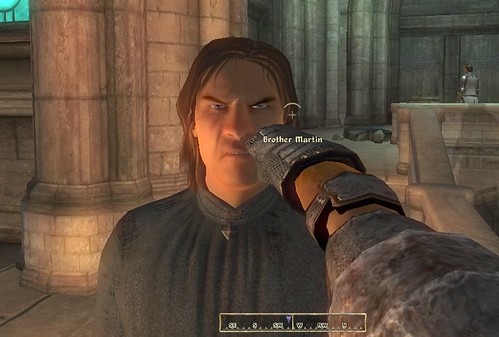
Oblivion’s main quest wasn’t unusually long, bad, or difficult, but it’s rare to actually find someone who bothered with it. The overbearing waffle of the introduction didn’t help, but I think it’s mostly that we just don’t want a single, long main questline in open world games. A primary story that’s the same for every player sits awkwardly in a game about freedom and customisation, and Oblivion’s sits more awkwardly still if you attempt it as the wrong class or at the wrong level.
You could have no main quest, but that might feel aimless or trivial. Even if we don’t do it, the existence of a main quest gives purpose to the world.
So what if the main quest was split up and woven into the guild questlines? People actually do those, because you can pick one that makes sense for your character and suits your style of play. In the case of Oblivion’s demons-invade main plot, each questline could have three key missions where the guild business brings you into contact with the invasion:
- One in which you first discover the demons in the course of your work.
- One in which the escalating invasion directly affects the guild and becomes a priority.
- One in which you find and kill a Daedric Prince and end the invasion.
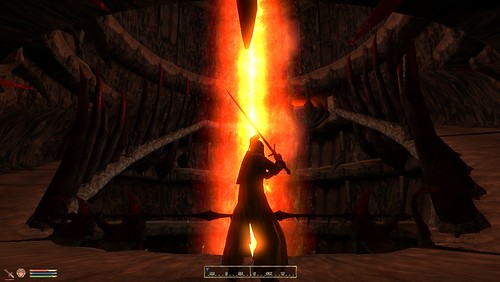
Luckily, the guild questlines are already structured into three neat groups of quests. These special missions could come between each group, like this:
Fighter’s Guild
- Five quests for Burz gro-Khash in Cheydinhal.
- Main Quest 1: you’re hired to investigate the disappearence of a small expedition of travellers. You find them all slaughtered, and follow the trail of blood to encounter a single Dremora, who you kill. The guild are disturbed, but want more info.
- Five quests for Azzan in Anvil.
- Main Quest 2: a portal opens near Chorrol, and the overwhelmed city guard enlist the Fighter’s Guild to help their defense. In the aftermath of the battle, the Blackwood Company move in and exploit the lack of Imperial presence to take over the town and extort its citizens.
- Five quests for Modryn Oreyn in Chorrol against the Blackwood Company, culminating in their termination.
- Main Quest 3: a portal opens outside the Imperial City and you, as guildmaster of the Fighters’ Guild, are called to deal with it. You lead a team of the key guild characters through to face a Daedric Prince. It’s almost impervious to your attacks, but Modryn has brought some confiscated Blackwood Company Hist Sap for you as a last resort. Drugged up, you’re strong enough to kill it and end the invasion.
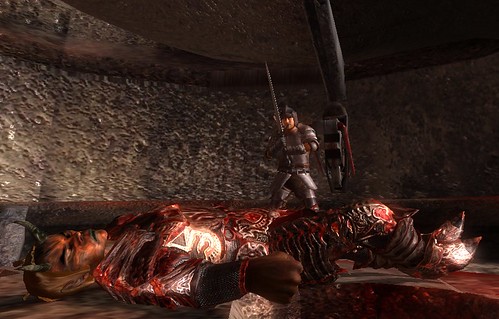
If you haven’t got far enough in any other guild questlines at that point to have encountered invasions during them, it’s not made clear to you at this point that you’ve only truly quelled a quarter of the demonic forces about to break through to this realm.
Once you have, you’re sent to see Raminus Polus at the Arcane University who explains their mystic types had feared as much: that the prince you vanquished was one of many. From there, the other guild questlines would unfold as if they were your first, each woven into a demon invasion of a different part of Cyrodiil, each of which is ultimately stopped in a style befitting that guild’s unique talents. It’s a bit redundant to say things like that in vague terms, so specifically:
Thieves’ Guild
- Four quests for Armande Christophe in the Imperial City.
- Main Quest 1: a wealthy home is found half-destroyed, its valuables ripe for the picking. During your escape, you brush witht he daedric forces that destroyed it.
- Three quests for S’Krivva in Bravil.
- Main Quest 2: creatures start appearing near Anvil, a prelude to a portal opening. You have to get Hieronymus Lex and his best guards reassigned to that city to better protect it. (This is the same as S’Krivva’s fourth quest, only the context and motive are different.)
- Four quests for the Gray Fox, gathering esoteric artifacts to use in the theft of an Elder Scroll.
- Main Quest 3: The Scroll details how to close an Oblivion portal, but the Empire were refusing to consult because it involves dark magic. The method requires a filled Black Soul Gem to be brought to the heart of the Oblivion plane, so you have to locate and steal one, then sneak your way into hell itself to collapse that realm, killing the Daedric Prince inside.
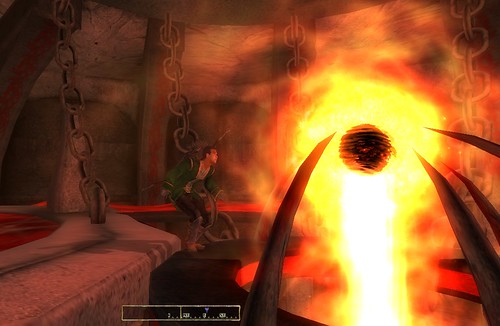
Mage’s Guild:
- Seven ‘recommendation’ quests.
- Main Quest 1: Your final recommendation quest involves a summoning spell that unexpectedly brings forth a Dremora. It slaughters a guild member before you can bring it down.
- Four quests for Raminus Polus.
- Main Quest 2: Your research for Raminus on Black Soul Gems suggest they might have caused the Dremora’s appearence. You’re tasked with replicating the event, which backfires and briefly sucks you into Oblivion.
- Seven quests for Hannibal Travern further investigating Black Soul Gems and Necromancy.
- Main Quest 3: The Necromancer King you kill at the end of Hannibal’s quests was responsible for the dimensional breach. You use his staff to intentionally summon a Daedra Prince to this realm and take him on, with your guildmates.
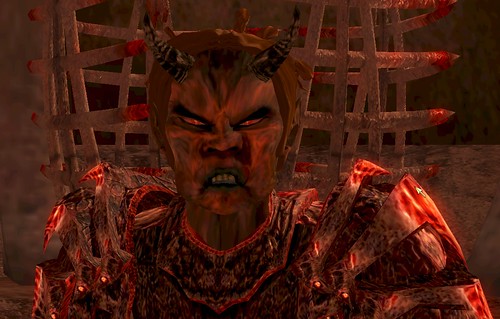
Dark Brotherhood:
- Four quests for Vicente Valtieri.
- Main Quest 1: an early target turns out to be a Mythic Dawn member, and Daedric creatures spill forth as he dies.
- Four quests for Ocheeva.
- Main Quest 2: Lucien believes the Mythic Dawn have infiltrated the Brotherhood, and charges you with rooting out their agent the only sure way, as in The Purification.
- Seven dead-drop quests after Lucien sends you into hiding.
- Main Quest 3: The Mythic Dawn agent is alive and has been tampering with your orders. When you’ve rooted him out, you’re made Listener and entrusted with what the agent was after: a perfect blade capable of slaying even a Daedric Prince. The Night Mother can transport you to his realm, but he can only be killed if caught unawares.
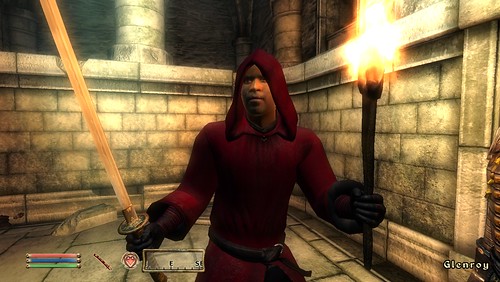
Dedicated players may ultimately do all four questlines, and a final Main Quest chunk ought to wrap them up and confer a final reward. But most people would probably play the same amount of Oblivion as they already do. The point is not to try to make players see more of the game’s content, but to turn missed content from a negative thing to a positive thing.
Right now it’s a negative thing because people get bored with the long linear quest, or struggle with it because it’s not for their class, or don’t want to do the standard thing. They don’t know how much they’re missing, and they feel indifferent or even guilty about missing it.
If it were split, the stuff you don’t end up playing is just paths not taken, and the more of them there are the more meaningful and personal your choice feels. Spending masses of time and money on content most players will never see is inevitable when making an open-world game. But if it’s structured in many strands rather than one long line, unplayed content can have a positive effect on even the players who don’t play it.
Prototype Revised
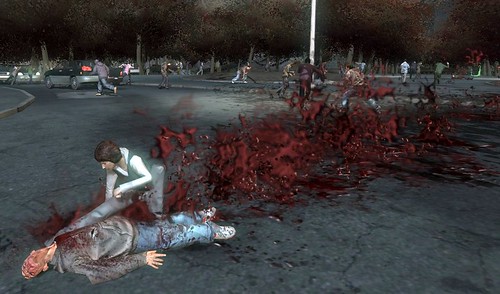
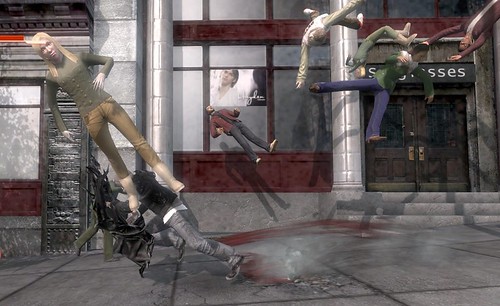
Prototype’s a game about having absurd powers – here I am surfing a man’s corpse – and you earn a steady stream of new ones until the end of the game. Those powers are what makes it fun. But the sheer number you have access to by the end of the game turns the controls into a finger-breakingly awkward mess of accidental stunts misfiring while you desperately will your hoodied twat to do what that combination of buttons used to or should do.
There’s also a redundant level of redundant redundancy: there are about seven powers that deal damage to everyone around you, and no reason to use any but the one that deals the most. The best powers are good against both large infected like Hunters and armoured vehicles like Tanks, and the only other type of enemy, crowds of zombies or soldiers, are never a threat. You fall into a pattern of using the most powerful for every situation, and your brain disengages.
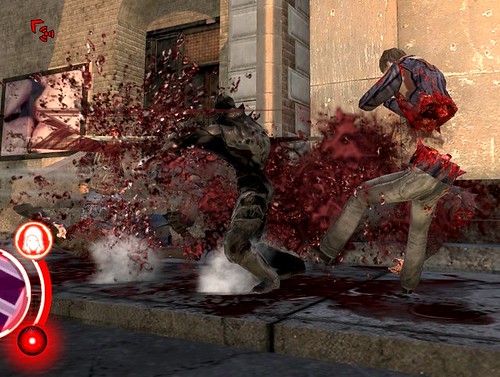
I’d trim the powers dramatically and give each set a narrower range of uses, so there’s a reason to switch between them. I’d also make each upgradable three times, so that you still have loads of options for what to spend your experience on.
I’d also want dangerous enemies among the crowds: military deathsquads with guns customised to seriously hurt you, and proto-zombies with claws like yours that really sting if they reach you in one piece. It’d give power sets one more thing to be good or bad at, and coupled with stronger differentiation could require that you actually think about which to use and upgrade. Here’s how it’d work:
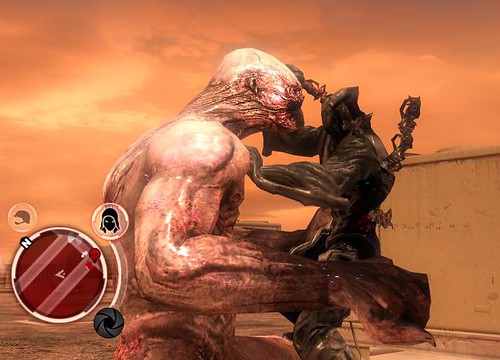
This power doesn’t let you do anything new, just increases the damage of all your basic combat moves. There’s no point in using it until you upgrade it to be more damaging than your proper powers, when it becomes so powerful that there’s no point in using anything else. In both cases, it poses no interesting decisions. I’d scrap it completely.
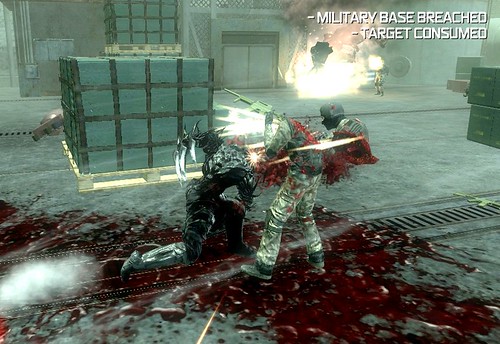
Primary attack: slash while running. Lets you plough through crowds hardly breaking pace, is okay against Hunters, bad against tanks. Upgrades increase the speed you move while attacking, up to full sprint.
Secondary attack: digs one hand into the ground to stop dead and swing the round in a wide arc, doing damage proportional to your speed when used. Decent against everything.
Jumping attack: lunges claws-first at a target, skewering fleshy ones or latching onto vehicles for a hijack. Upgades increase how far you can lunge.
Currently, since claws are less damaging and no faster than other powers, they’re just flat out worse. I’d make this the only mode in which you can pick up and throw large objects. Picking up the wrong thing is the number 2 cause of death among prototypes, a recent study revealed, so assigning one mode to be the chuck-stuff mode means you’re never going to grab a taxi instead of an army sergeant in any other mode. In a similar vein, you should be able to pick up weapons in any power mode, only when you’re a normal human.
The previous Claws secondary attack was cool but had little to do with claws – I’d keep it as a Devastator move instead.
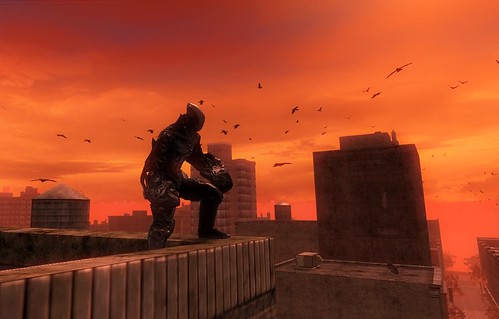
Primary attack: pounds slowly directly ahead, no splash damage. Slow against crowds, okay against Hunters, great against tanks.
Secondary attack: flings yourself at targeted enemy rocky fist first, as in the Hammertoss. Upgrades increase damage and range.
Jumping attack: elbow drop, as current, damage increases with height.
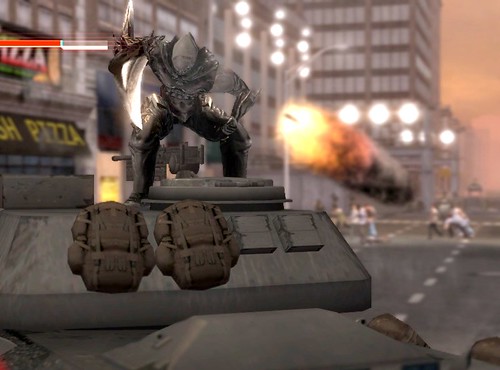
The idea is that this mode should be all about flinging your enormous weight about, dropping on stuff and knocking choppers out of the air. Right now this is an anti-tank mode that’s not as good against tanks as Blade or Musclemass, and its star move is an elbow drop that’s not as good as the Musclemass Bullet Dive, so it’s utterly redundant.
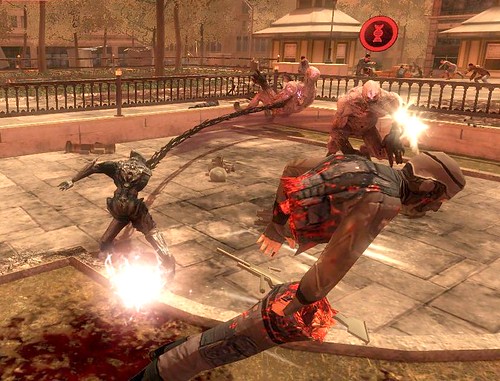
Primary attack: Whips ahead, killing things in a long but narrow cone. Meek against everything, but potentially hits more stuff at once. Upgrades increase length of whip and hence size of cone.
Secondary attack: pulls a single target towards you and puts your fist through them. Upgrades increase pulling force: down a chopper or skewer a Hunter at level 3.
Jumping attack: swings your whip arm down beneath you like a giant deadly skipping rope, batting everything beneath away. Upgrades increase the area it covers.
This mode would still be for when you’re concentrating on a specific target, whether to hijack it, eliminate it quickly or keep damaging it while staying away from it.
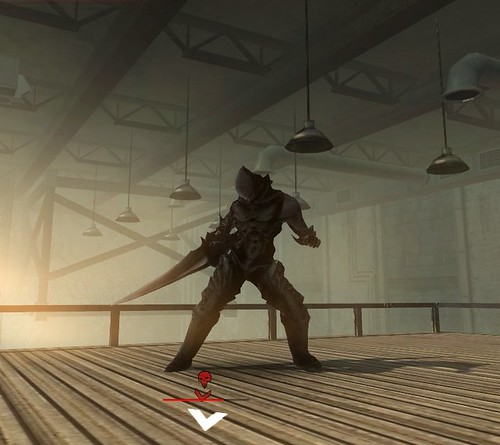
Primary attack: slashes and moves forwards at a decent rate. Okay for crowds, great for Hunters, not great for tanks. Upgrades increase speed.
Secondary attack: dashes forwards with blade vertical, splitting anyone in your way. Upgrades increase how far this dash takes you.
Jumping attack: as current.
The only trouble with Blade as it stands is that it’s great against tanks too, which makes everything else except Musclemass obsolete. And Musclemass makes Blade obsolete.
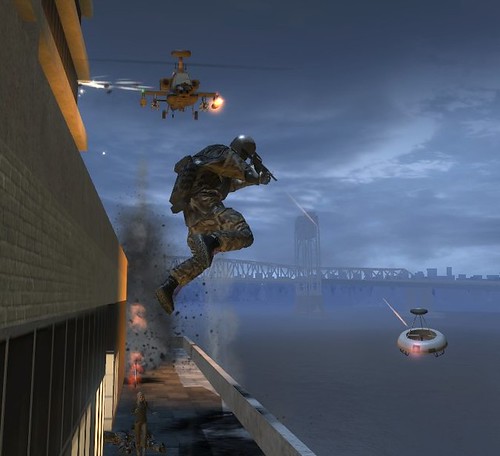
All moves scrapped except punch, kick, flying kick and bodysurf. Anything that doesn’t require a specific keypress can stay in as an automatic flourish. And as mentioned, this is now the only mode in which you can pick up and use weapons.
Useless, all scrapped for simplicity.
Shield: as current, but upgradable to increase the amount of damage it can take before breaking.
Dodge: new mode – automatically dashes you out of the way of incoming projectiles and blows. Upgrades increase how soon after dashing the power is ready to save you again.
Armour: as current, but upgradable to decrease the damage taken while wearing it.
I like the current ones, but I’d like even more the ability to specialise, find cool combos of Defense and Offense powers, then upgrade the bejesus out of them.
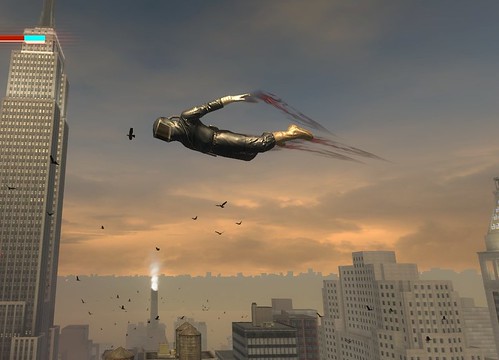
Free running is already fun, but it’s reliant on using this very artificial airdash that shoots you forwards in a not very physically convincing way. It also really hurts my fingers to do it a lot. I’d like it if, once you were airbourne, there was only one control:
Glide: press jump while airborne to toggle. All your velocity, downward and otherwise, is translated into forward velocity, letting you get enormous speeds by jumping from a great height and activating it at the last minute. Once gliding, you can angle it up to gain height and lose a bit of speed, or down to lose height and gain speed. The idea is to combine it with wall-runs along skyscrapers to gain height without losing speed, then spend that height on an extra boost by diving.
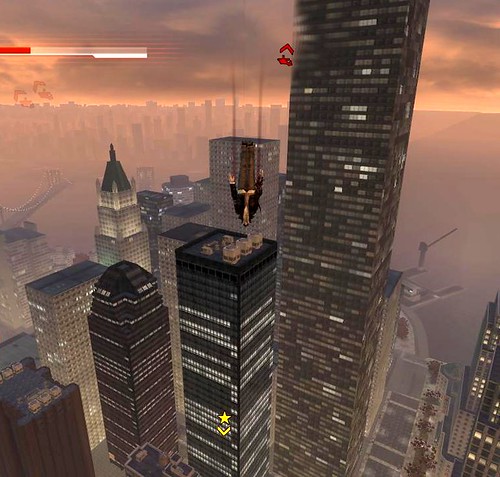
Currently, Prototype has over fifty distinct powers that require different button combinations. This would be a little over twenty, all told; none that require simultaneous button presses and none with overlapping controls. But the hope is that it’d make it a more complex game, because the fifty powers it currently has don’t have even twenty meaningfully diffrent uses – they have about six.
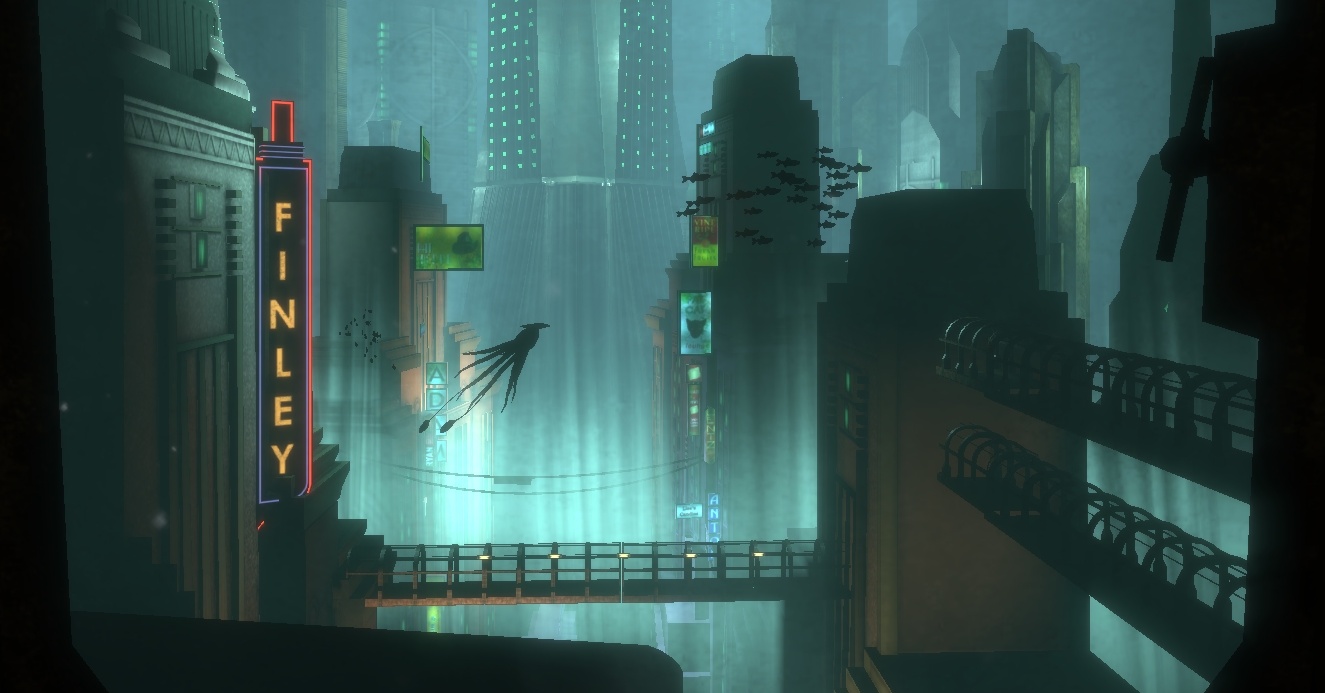
A Different Idea For Ending BioShock
BioShock Spoilers
This is my idea, in ten steps, for how BioShock could have unfolded after your encounter with Andrew Ryan in his office. It was written in 2009, but coming back to it in 2020, I feel like I should clarify a couple of things at the top:
- Although I did vaguely try to limit myself to stuff that’s not too outlandish, I actually have no idea what it’s like to make a game of this kind so I don’t claim my version is practical in scope.
- It obviously comes from dissatisfactions with BioShock’s actual ending, but I’m not imagining those were down to a lack of ideas. I know games are made under unseen constraints, triple-A games triply so. It’s very easy to sit back and do armchair game design, and it’s also very fun, and you also can’t stop me, so here we are.
Keeping The Peace In Mirror’s Edge
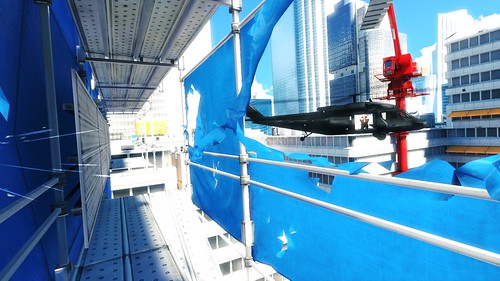
It turns out that if you start talking about Mirror’s Edge in the Future offices, pretty soon a small crowd gathers to weigh in. In a group of editors and writers – one who gave it nine out of ten and another who thinks five was too high – it turns out we mostly agree. We all love to run, and we all get angry when we’re stopped by something difficult.
Most of my suggestions for the combat with cops would make it less difficult, and hopefully less awkward. But it can’t get so easy that you don’t feel threatened, and the grander issue is that it needs to be more avoidable. So this is about that.
The police choppers already work well as a propulsive force for the chase sequences that doesn’t often lead to death or frustration. But I’d like to change each of the three types of ground enemies, and how they’re used.

Cops: Not allowed to fire until they’ve issued two verbal warnings (“Freeze!” – “Stop or I will shoot!”) giving you a window to take one out or escape. Obviously once you’ve attacked one, others in the area can open fire. When they do hit, damage is much more serious – two hits kill – but they’re still wildly inaccurate. It becomes more of a tactical puzzle about how not to get shot, and the way forward never depends on turning a slow valve, climbing a slow pipe or working out where to head.
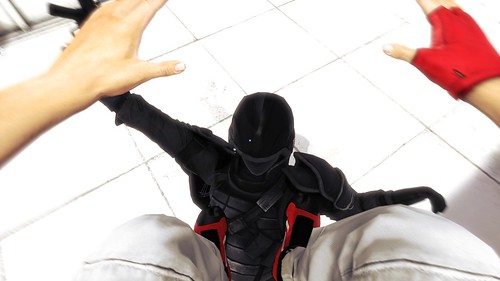
SWAT: Armoured and with two-handed weapons, these guys can’t be disarmed. But they’re only ever sent after you, so you never have to get past them to progress. They can be killed with stolen cop weapons, knocked out if you drop on them, or pushed into danger by a melee attack.
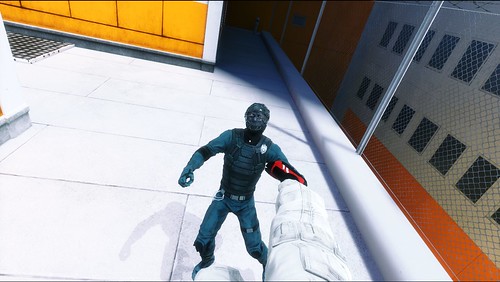
Chasers: Right now these guys have tazers, which are just kind of annoying. I think they should have mace. They should be knocked back by any melee move – to their death if they’re on a ledge – but if they get right up to you, they grab you and spray a blinding teargas in your eyes, sending your vision haywire and making you scream. You can try to flee while blinded, but if you don’t get away your third macing incapacitates you, and it’s game over.
Being chased was the perfect way to escalate Mirror’s Edge, but the Pursuit Cops are just so lame in combat; dancing about, tickling you with electricity and mild punching. I want to be freaking terrified of these guys. It would help if they didn’t look like dorks.

So one set is easy to deal with, another is hard to deal with but easy to avoid, and the last is hard to deal with or avoid – so do whichever you’re best at. I found lots of fun ways to lure Chasers into positions where I could knock them off a building, but bizarre rules meant that more often than not, I was the one knocked back by the crucial blow.
I was saying the other day that no matter how often the game explicitly tells you to stop and fight, the player still tries to run right past. Replaying the early sections at lunch today, I realised there’s actually a forced pop-up message in the prologue chapter that says “Always try to get away from enemies.” It couldn’t feel more like two different games that were code-merged at the last minute.
The Combat In Mirror’s Edge And Why It Fucking Sucks
Having played it through three times in English and once in Italian, it’s starting to look like I might be obsessed with Mirror’s Edge. This is my fifth post about it, and not my last. But even I think the combat is weirdly bad, and so easily fixable that you start to wonder what went on in DICE’s offices. There’s no way they had a roomful of testers play this and everyone said “Yep, seems fine.”
The three parts of it suck in different ways, and my proposed fixes are of equal obviosity.
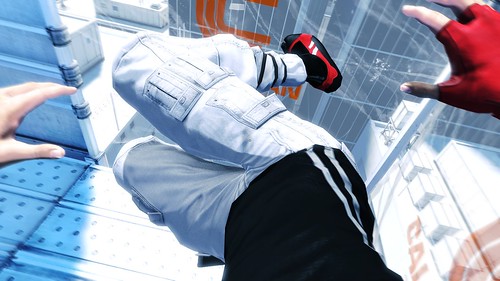
Like Tuesdays, the melee combat in Mirror’s Edge has no feel. Despite loading-screen guff about run-ups giving your flying kicks more damage, every blow bounces off every enemy, triggering a fake ‘stagger’ animation. Nothing is physical, everything is the result of abstract rules.
If I, an unarmed action hero, manage to run at a firing gunman and flying-kick him in the face before he kills me, it has to knock him down. Look into your hearts, DICE, you know this to be true. It’s a fundamental axiom of awesome, like glass breaking when I dive through it. The same goes for slide-kicks to the groin, which should lift your victim momentarily from the ground as he’s propelled backwards onto his ass.
Punches should be weak, of course, which is precisely why there shouldn’t be any. You’re a slim woman with unprotected hands, it’s just not wise to hit someone wearing full body armour. If you’re sprinting when you collide with them, the impact should make them stagger. If you’re stationary, Attack should do the same as Disarm – recall that the Disarm button is actually the “Beat them up and disarm them” button.

Waiting for an enemy’s weapon to flash red during a specific frame of the same nonsensical shoulder-nudge they each perform is preposterous. I feel like I’m standing there as a favour to the game’s animators, because they only know how to show me grabbing a wrist in one particular position. It’s a terrible challenge, relying either on using slow-mo so slow that the wait becomes boring, or learning the animations by rote to anticipate the absurdly brief red flash.
Design tip! You’re supposed to hide – not force me to study – ridiculous conceits like canned animations.
Disarming should always work – slowly if they’re firing at you when you initiate it, quickly if they’re staggered or prone. Enemies shouldn’t try to nudge you with their weapons in close combat: you’re still in front of their gun, there’s no reason for them to stop firing. Instead they should start to run backwards as you approach, trying to keep you at a distance.
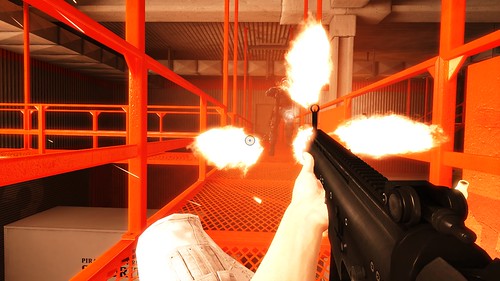
I love all the different words reviewers have found for this: loose, hollow, shaky, weak, fuzzy, bland. Obviously to make an unprecedented free-running game you can’t devote the time and budget it would take to make a really punchy shooter too. I wish DICE had seen the bright side of this, though: they didn’t have to! Shooting doesn’t have to take up the player’s time or be their source of fun. You can just have guns outright fucking kill people, the way they actually would.
Hitman’s the closest model of what I’m talking about: it doesn’t make a great shooter and it doesn’t have to. You spend most of your time in situations where you can’t viably open fire, so enemies don’t have to be tough and interesting challenges when you do. They can just die.
Once you’ve got hold of a gun in Mirror’s Edge, it should make a lot of noise, have a lot of kick, miss a lot at range, but kill when it hits.
If some of this sounds like it would make the combat too easy, that might be because I think the combat should be easy. But I also think it should be used in a completely different way, and I think I’m going to have to make that post number 6.
P.S. Graham’s blog Zeitgasm has also been redesigned, and is also harping on about Mirror’s Edge in tones I mostly agree with. 83% though, honestly.
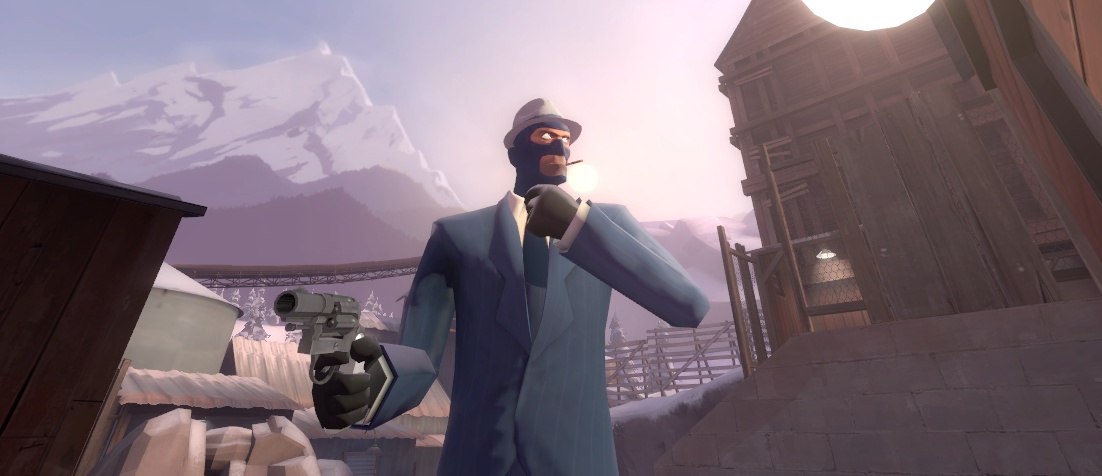
My Script For A Team Fortress 2 Short About The Spy
To commemorate my 100th hour playing as him, and since he’s clearly next in Valve’s update schedule, it seemed appropriate to take a swing at a Meet The Spy script. Continued
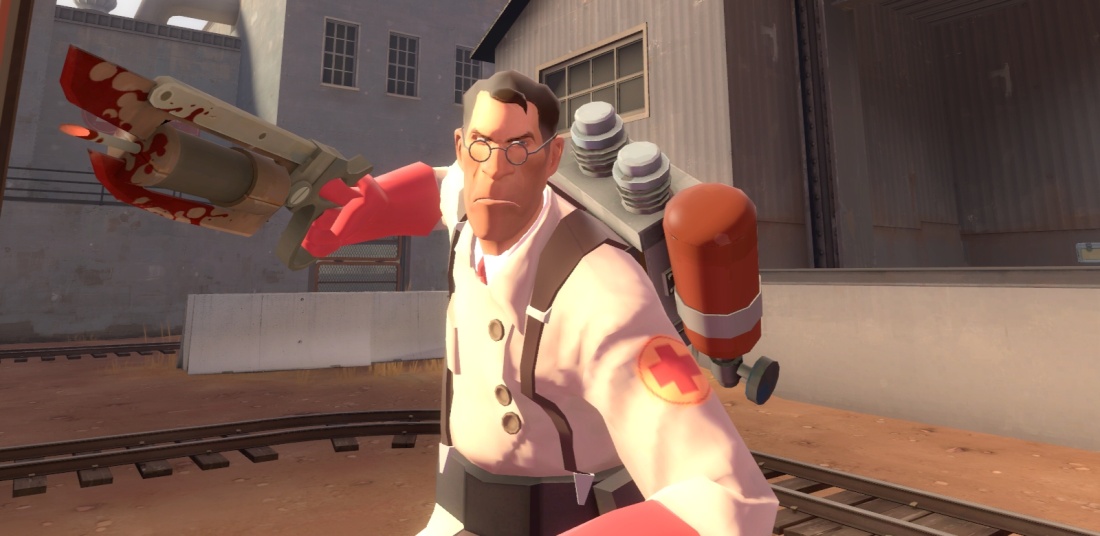
Team Fortress 2 Unlockable Weapon Ideas
Update: This post was written in May 2008, when only the Medic had new weapons. Since then, some weapons have been added that have similar concepts to these. Valve even gave me a special sparkly Equalizer (similar to the Last Ditch Digger here) and a lovely shoutout in the Solider update.
Obviously we’ve all thought about this a bit at one point or another. I thought the most interesting way of doing it would be to think up just one alternative to every weapon, device and ability in the game. Then I realised there are 29 of them, and did it anyway. I hadn’t originally planned on illustrating them – for reasons I hope will be obvious once you see my illustrations – that just kind of happened. Sorry. Continued
Quest Ideas
1. The Invincible Hero
You are ein superhero – perhaps of your own design. One super-power that wouldn’t be up to you, though, is invincibility. You cannot die.
But wait! Where would the challenge be?
I put it to you, sir, that you cannot die in any game. Termination of your current existence leads to reloading of an old savegame, or respawning in a different location. In the first case, the death is erased from history and never happened, and the second is not death by any sane definition of the word. Death, look it up, is pretty permanent.
Currently, games punish you for your character expiring. A huge problem with all games is that they don’t know by how much – the inconvenience may be a matter of replaying the last few seconds, or trundling down the road from the respawn point (not just deathmatch games – WoW and San Andreas both use this). Or it could be hours of work, or a huge, utterly dull journey back to where you were. This is disastrous. It’s enormously off-putting to new gamers, incredibly frustrating for existing ones, and any dissatisfaction you felt with the game – particularly if it’s related to the reason for your character’s demise – is magnified tenfold. Modern games like Half-Life 2 do a good job at trying to limit this, with both frequent auto-saves and unlimited quicksaves (of which, by the way, it stores your last two – an achingly sensible precaution I’ve been begging for for years). I’d like to see time-based autosaves (every five minutes, keeps the latest two of these) in tandem with crucial event autosaves (so you can go back and make an important decision differently hours later) and manual quicksaves (for the personal touch). But let’s see what happens if you can’t die.
Superheroes don’t die a lot anyway – hardly ever. The risk is never their own demise, it’s that they might fail. And the objective they might fail at is almost always saving someone.
But wait! Failing is just like dying, only worse because you don’t see why you should have to restart when you’re not dead.
Yeah. Let’s do away with that too.
So you can’t fail?
The exact opposite: you can fail. It’s okay. You carry on. Lives were lost, it was partially your fault, but there’s no reason to force you to erase that part of your life and save everyone.
What’s to stop people reloading and making sure they do save everyone?
There’s no overwhelming reason to stop this, but I will anyway just because it ought to be interesting: you can’t save. You can pause the game, in case the phone rings or whatever, and when you quit the game it auto-saves before it exits, but when you start it back up it loads that save and deletes it. Short of restarting the game completely, you have to live with your mistakes.
So how do enemies stop you from saving people?
By killing them, duh. There are three ways for this to work:
a) The hostage situation. Easily the best excuse for stealth in any game – you have to take out the hostage-takers before they realise an attempt to do so is even underway. If they smell a rat, they’ll do it. Sometimes you’ll save one but in doing so alert another HT and lose the corresponding H or Hs. Sometimes you’ll do it perfectly, an artwork of silent takedowns, goon avoidance and lateral thinking. Sometimes you’ll screw it up and everyone will die, and however many goons you beat up in vengeance, you’ll still feel empty inside and you’ll still know it was your fault. This is what games should be all about – making you feel bad.
b) The time limit. There’s nothing stopping you, but bullets will slow you, enemies will wrestle you to the ground and powerful blows will knock you down. And if you don’t get to the bomb before it detonates – the psycho before he reaches the victims – the controls before the plane crashes – hundreds of people will die. Being fast means dodging bullets, incapacitating nasty bad guys swiftly and dashing by the rest.
c) The villain. He’s as fast as you, as strong as you and also completely invincible. He’ll pounce on you as you try to get to the innocents or the weapon of mass destruction and throw you to the floor, fling you across the room, grab you by the neck, smash you to the ground. Sometimes it’ll be the other way around – he’s trying to get to the objective and you’re trying to stop him. In both cases it’s a case of administering a blow that causes your opponent enough grief to give you time to get to the objective and do what you need to do before they catch you up. I’d love to see a system whereby prone-time is proportional to the force in newtons administered to your head – so if you use the physics system perfectly and drop the corner of a concrete block on his eye, he’s down for the count.
Naturally any mission could be a combination of these – you only have a certain time after the goons discover you to get to the hostages before the villain does, and if you meet each other first it’s the fight that’ll determine the winner. It should also go without saying that we’ll need a ragdoll recovery system, whereby someone flung across the room with ragdoll physics knows how to get back up and into normal animations without too big a glitch. No small feat, but I’ve heard it’s now possible. Knocking a villain down will allow you to drag him into a position to be victim to an even more devastating attack – chuck him under a falling block of masonry, throw him into a meat-grinder. And being invincible shouldn’t mean this stuff doesn’t hurt – getting shot in the face should be a blackout as well as a knockdown, and when you awake in a second’s time, you’re groggy and weak. A good punch causes vision blurring, and sometimes you’ll be taking so many hits you can hardly see or run in a straight line.
Success would mean feeling like a real hero, genuinely making a meaningful difference and feeling cool. Failure would be tragedy rather than irritation – no chore, no inconvenience, just irreplacable loss and anger at yourself. Sadness is something other mediums relish in making you feel, but games aren’t very good at yet. It is – like fear on a rollercoaster – a good thing. Irritation is never good, and games are extraordinarily adept at inspiring it at the moment.