|
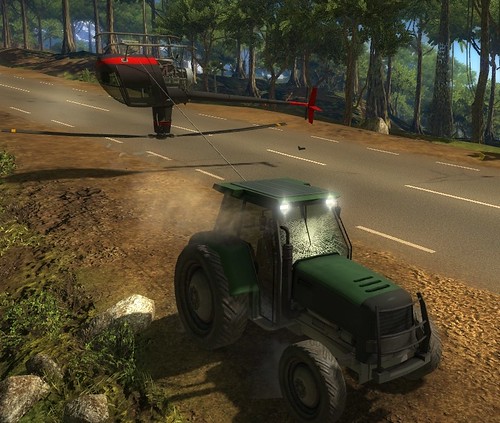
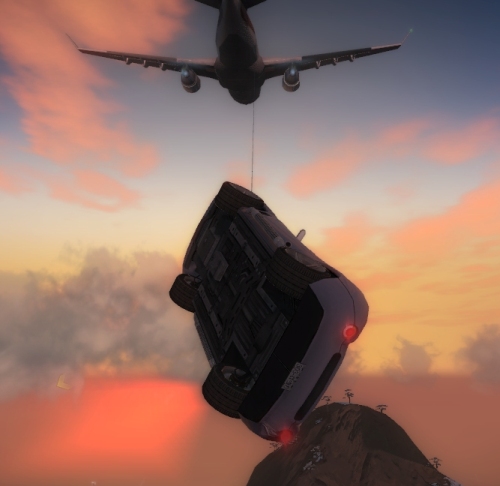
Just Cause 2 is now a real thing people are playing. And, more gratifyingly for me, a much yakked-about Big Deal in the way the first never was. This is the sequel to a unique and majestic game that I haven’t stopped playing in the four years since it came out, but one so many people were maddeningly dismissive of. However deliriously excited I got for the sequel, I was never confident it could vault the bizarre wall of apathy some people erect around phenomenal works that come from unrecognised sources. It’s gone down so well that – and you couldn’t say this of the first game – there may actually be people in the world who like it more than me. Not by a lot. It’s the ultimate screw-around game, and I love screwing around; I spend 80% of my gaming life doing it. I have answered the question “What are you doing?” with “Stabbing this explosive barrel to see if that makes it blow up.” Just Cause 2 makes me realise that, in a lot of those cases, I wasn’t screwing around in a sandbox. I was blundering drunkenly onto a movie set, punching the love interest and setting off the pyrotechics. Here, though, I’m screwing around with things that were pretty much put there to be screwed with. Avalanche had a feeling I might tie a tank to a passenger jet at take-off, so they made sure I could. It’s an amazing feeling, and no game has ever really catered to it like this. Played at its best, Just Cause 2 is raw science: curiosity, experiment, volatile result. But it is catered to. These elements were put here for me to mess up, and for that reason none of them are important. I am a destructive child whose attentive parents have given him things they can afford to lose. Toys. I can tie a tank to a passenger jet, but it’s a tank and a passenger jet. The game has more, and they’ll spawn in seconds. I’m interested in the physical result of my tinkering, but I already know the real result: nothing. Nothing can ever happen. They can’t give me anything significant, because they know I’d tie it to a ski lift until it split in two. Missions can make a helicopter the objective, but that doesn’t make it important – it just bolts on an arbitrary failure state. Missions provide a sort of ‘serving suggestion’ for the mayhem, but they don’t spice it up. So I’m in the playpen. On the up side: woo! Playing! On the down: I kinda want to fuck with the grown up stuff after a while. Because I’m not just a child, a scientist, and a brat. I’m a tempest of genuine malice, a power-thirsty psychopath with a crowbar of dysfunction. I want to tinker, but not just with the Mechano set. I want to break the car. I’m not saying I need more power in Just Cause 2: I’m already a demon, and the mods make me a God. I want things to have power over. The Colonels are a start: named, unique, significant, killable. But I don’t want to “lower military morale”. Some of the stuff I’ve done in this game would scare nations. I want that popup text to read “Holy fuck. What have you done. Everything is dead.” I want to conquer whole regions when this stuff happens: not easily, not through superpowers, and not right away. But I want whatever ridiculous stuff I screw around with to have an effect I can point to. These aren’t reasons I don’t like the game. I’ve played it seventy hours, it surpasses one of my all-time favourites in nearly every way, and it’s the most astonishing piece of technology my machine has ever crunched. This is just to paint a picture of where I’d like to see stuff like this go next. Avalanche have conquered the screw-around game to an extent it would have taken backward cinephiles like Rockstar a decade to catch up with. Now I’m interested in the fuck-it-up game: something where I’m allowed to break what they can’t easily replace, and throw a spanner in a machine so large it does something more violent and terrible than explode and respawn.
More Just Cause
| ||
Tuuvan: There was one moment in the game that was awesome in concept and fits in the "Fuck it Up" category of game, which was the mission that involved the island in the upper left. I won't go into it too much for those that haven't done that mission yet, but if the major set piece there had been transplanted to a more prominent location (and maybe tuned down a bit), I think there could have been even more catharsis involved in its destruction (or better yet, in its assimilation).
| ||||
|
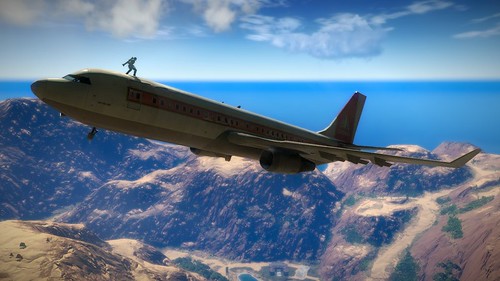
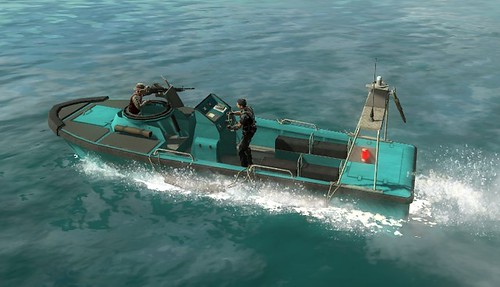
The last post was figuring out what we all like in open world games; this one’s about how to make that stuff work together. Can you include it all in one game, and still avoid theme-park silliness and repetitive grinding? No, probably not, but the ideas that crop up when you try are interesting. I had to pick a specific open world to talk about to prevent this from becoming hopelessly vague, so these are all ideas for how a game like Just Cause 2 could work. I chose that not because of any qualms with it, but because the first one was a classic example of a wonderful open world, gorgeous and fun to move around in, without much going on in it. The sequel’s even more inviting and even more fun to traverse, so it’s a great chassis to plug some cool ideas into. This got long, so first I’ll summarise: Give the player the option to set up camp in his favourite place, upgrade it with the features he wants, and liberate other areas he likes through a simple but high-level strategy game played out on the world map. Split the main story into separate series of missions with a common theme – Sabotage, Assassination and Heroics. They have the appeal of categorised side-missions because you get to choose what kind of challenge you feel like taking on, but they’re unique and story-driven so they don’t wear thin. Litter the world with obvious opportunities: a network of drug dealers with hugely varying prices that invite you to embark on your own travel missions, convoys carrying precious cargo that invite you to attack them, and rare assassination targets whose deaths will help you on the strategy map. Thoughtfully place sets of collectibles that tell the story of long-dead agents like you as you collect them, encouraging you to explore, making the world feel like it has a history, and improving your character with the upgrades and unique weapons they left behind. The first thing you do, after base-jumping into the island, meeting your handler and a short introductory mission, is choose where to set up camp. You pinpoint the precise location in-game – a secluded bay, a mountain top, a waterfall, the roof of a skyscraper – and a package is airdropped that unfolds itself into a tent. You can fast-travel there, lose your alert level, make a permanent save, or rest until a set time. Incredible Bulk 92 For every twenty or so locations you find – towns, islands, bases, villas, mountains, etc – you’re given the option of calling in another base of operations somewhere else. When you get your first Revolutionary (explained next), you have to pick somewhere within a certain radius of a camp to place a comm antenna and laptop. You have to use this to issue orders on the strategic map. You can also add other bits of equipment to any of your bases by stealing them from military bases and government facilities. These are marked with a special logo, and you can just tether one to a vehicle and drive off to rip it out. If you make it out of the area with the item intact and in tow, the agency airlifts it out and you can choose where to put it near one of your camps. Camp bits: Tent – pass time, save game (earned by exploring) The idea is to encourage the player to have a favourite place, and give him a way of making it significant. There aren’t many practical considerations: it doesn’t have to be near anything or easy to get to, since you can fast travel to it. So it gets you looking at the world aesthetically, something a world like Just Cause’s definitely warrants. DoctorDisaster The extra features give an ongoing way to improve and customise your camps as you start to engage with more of the world, keeping them relevant, personal and distinct as you progress through the game. Dante After about five missions, you’ve stuck it to the man enough to inspire some of the locals to rebel – including a Revolutionary leader. On the map, you can send this guy to any region and he’ll Liberate it: he and his band of rebels battle any present military forces and will keep them out indefinitely, making the area a bustling and vibrant safe zone. A few missions later, the country’s President sends an Officer to lock down the region next to his residence, putting it under Martial Law. Constant military presence, very low tolerance for misbehavior, shops, services and base camp fast-travel disabled. Each time you send out a Revolutionary, he’ll lock down more of the island in response. If you’ve Liberated a region next to one under Martial Law, you can use your next Revolutionary to attack it. Your guy and his rebels invade, and the resident Officer emerges with his own troops. Chances of success are even, but you can join in the fight to make the odds much better. If you win and your Revolutionary survives, the region is Liberated. If both the Revolutionary and the Officer die, the region reverts to normal. Each time you make a move on the strategic map – and the government makes one in response – you both get one new leader for every two neighbouring regions you control. So you want to keep your territories joined, and break up the enemy’s. You can pile more Revolutionaries into an already Liberated region and send them all to attack a neighbouring government territory at once, to ensure victory without having to show up in person. Jazmeister The idea is to let you fight for areas you like with visible effect, to give regions strategic significance, to create a world that changes in response to your actions, and to give you something to think about while messing around. It gives a visual sense of what you’ve achieved, what you’re up against, and how each mission is getting you closer to your objective. And by linking in with Convoy and Target Opportunities, it gives those context and significance beyond fun things to do. The actual rules of the game, particularly the reinforcement mechanic, work magnificently in the super-simple Flash game Dice Wars. Your mission is to overthrow the President of this island state, which you go about in three different ways. These mission threads are separate, so you can alternate between them or just burn through one type that suits you. Sabotage: A series of missions offered by your handler to cripple the local military by destroying their hardware and facilities, either strategically or with brute force. Missions typically have you taking on a large but not limitless force and culminate in the destruction of one vital asset. Eg. Fighting your way through fighter jets and boats to scuttle a battleship at sea. Assassination: A series of missions given through dead drops by an Agency operative you never meet, to eliminate well-protected key personnel in the local military. Missions usually pit you against a vastly superior force but with a suggested way to avoid them. Eg. Hopping on top of a civilian passenger jet to fly over an island base with heavy anti-air, to drop in on a target there from above. Heroics: A series of missions given by coded messages broadcast on the local radio, by an operative pretending to be a rebel to convince the locals there’s already an insurgency for them to join. Missions are about using carefully setting up then pulling off spectacular victories, and always have some optional bonus objective that’ll make your actions all the more inspiring to the populace. Eg. Stealing a government Death Squad’s ammo reserves the night before an attack, with the option to sneak in convincing blanks so they don’t realise until they open fire. Devlosirrus The idea is to give the player a clear choice of what kind of challenge he wants to take on, but without resorting to boilerplate template missions or fairground challenges. These are still story-driven campaigns of unique missions, you just get to pick what type you’re in the mood for – and even avoid some of your least favourites entirely. Phill Cameron Each mission series ties its jobs together into an overarching story about the atrocities the regime has committed, the corruption of its officials, and the few local heroes trying to undermine or expose it. You know your Agency wants to overthrow him partly to get their own preferred candidate in power, but since that entails overthrowing a true despot, you’re happy to oblige. Near the end of each series, though, your work gets harder to rationalise. Destruction missions start to include facilities with hundreds of people inside, Assassinations shift from military to political targets, and the new leader your Heroics missions are promoting starts to show a darker side. The last mission in each firmly crosses the line, and you can both voice your concerns and refuse to do them without necessarily giving up the cause. You’re after the President, and he’ll only leave the bunker beneath his mansion when he’s lost control of the island – when there are no regions left under Martial Law. That’s extremely hard to achieve: halfway through your missions the government starts locking down regions much faster than you can earn Revolutionaries. But completing any of the three mission threads gives you a major advantage. Finishing the Sabotage missions deprives all Martial Law regions of hardware, meaning they can no longer invade your territories. Completing all Assassinations means the government runs out of Officers, so the ones already on the map are all they’ll ever get. And doing all the Heroics missions inspires the populace so much that you gain double the number of Revolutionaries each time you move. With a good strategy and skillful fighting on the ground, it’s possible to win the game without completing any of the mission threads – though you’ll have to come close in at least two of them to earn enough Revolutionaries. Finishing the game this way means you’ve avoided compromising yourself with any of the dubious final missions, so it unlocks a special Epilogue mission in which you can expose the new leader for the asshole he is, and instate one the local heroes you’ve encountered in the course of the missions – against your Agency’s orders. Once you have freed the island of government control, the President uses every asset he has left to make a mad dash for the airport on the other side of the island. Three convoys of tanks and APCs, a squadron of attack helicopters and a fleet of gunboats all leave the palace area, and there’s no way of knowing which he’s in. You have half an hour to do at least one of three options. You can destroy all convoys before they reach the airport, to make sure he’s dead. You can try to take back the runways: the government has their last aircraft carrier stationed off the coast there, shooting down rebel air support, scrambling fighter jets and sending in boats of troops. Or you can fight for the terminal building itself, taking control of the government’s anti-air and gun emplacements, and laying mines on the approaching roads to ensure the convoys will be destroyed on arrival. The first is a very tough fight against vehicles, the second requires evasion and tactics, and the third mostly involves fighting a lot of infantry. None actually take half an hour, and failing doesn’t mean you have to restart, you just get a slightly different ending. But of course the player isn’t told that going in. Dealers lurk in backalleys of major cities, huts in remote villages, villas in the middle of nowhere, boats in the middle of the ocean. Their prices for each of four or five narcotics vary by region: nearby dealers have similar values, distant ones massively different. You can see how much dealers you’ve met are offering for what you have at a glance, on the map. But their prices fluctuate over time, so you have to move soon to get there while the price is high. They also change in response to your deals: sell a lot of cocaine and the price crashes in that area. The legal status of your cargo and questionable ethics of trading it make a good excuse for why you can’t fast-travel while carrying any drugs: if you try, you’re offered the option of instantly dumping your stash with the nearest dealer for whatever their current price is. If you’re feeling ethical, you can buy up drugs just to destroy them at your camp. And if you’re feeling zealous, you can just kill the dealers: they’ll stay dead. The idea is that this inspires the player to come up with his own travel missions, generated as a result of a changing system that will make different routes profitable at different times. Since the market evens out when he makes a big run, it’s not going to be lucrative to ‘grind’ trading for more than a few good deals every half hour or so, giving a natural motive to vary his activities. Embarking on a mission that was your own idea, for a reward that you’ve calculated, is much more satisfying than doing what you’re told. Devlosirrus You’ll sometimes see processions of vehicles of various types crossing the country – they’re always guarding something important, and you can always steal it. Military motorcade: truck carrying weapons. Take out its escorts without destroying it and you can grab a rare weapon from it: a high-tech assault rifle, sniper rifle, missile or grenade launcher, or a powerful demolitions charge. When a region’s under Martial Law, the Officer who locked it down is usually safe inside a building until it’s invaded by a Revolutionary. But rarely, they’ll leave and patrol the area with a team of elite soldiers. They’re tough and well protected, but if you can take one out before he gets back inside, Martial Law is ended. The idea is to provide a rare chance to make a real difference with a relatively quick and fun type of challenge. Once a large number of regions have fallen under Martial Law, you could even patrol them with a sniper rifle, hunting Officers but staying within the law until you spy one. I hate that term, because it encapsulates how tacky and incongruous these little scavenger hunts often feel in open worlds. But there’s definitely a large contingent of gamers who love them, and I think I’d be one of them if anyone ever did them well. They need to fit with the fiction to feel appropriate (like Assassin’s Creed 2′s feathers), they need to improve your character to be truly worth hunting for (like Crackdown’s Agility Orbs), they need to include scraps of story to make the world feel rich (like Fallout 3′s characters), they need to include unique items to feel special (like Fallout 3′s items), and they need to be common enough that you feel there could be one just over the next ridge, nook, clearing or summit (like Fallout 3′s quests). Here’s my idea: Some foreign, some from your own agency, all rotting away in the most secluded and obscure parts of the islands. They’d be tough to find, except that you’ll occasionally see a coloured light flash. You’ll find it’s a Beacon, the device agents like you use to call in air support or mark targets, and this agent’s other kit will be scattered in the area. The various bits you might find are: Beacon: its occasionally blinking light tips you off that there’s other stuff nearby Types of agent: Native: beacon light is green, they’ll have a main weapon but no Agency pistol or equipment. They’ll always have a PDA with some info on what they were up to, but usually no phone or memory card with full details. The idea is that finding this stuff is a little adventure that tells a story, in the order you discover it. Most will be fairly simple stories: guy was chasing some drug dealers, drove his speedboat off a waterfall and buried it into the side of a mountain. Luke But some, the ones with phones, tell the stories of people who shaped the history of the place. Finding all of these pieces together a subplot about your Agency putting the current president in power in the first place, by ruthless means. Finding this enables a special Epilogue mission after the main game is complete, to undermine the new regime before it gets started and put a local hero in power. Dante I mentioned both upgrades and finding special weapons above. The two don’t often work well together: if you can keep upgrading your favourite weapon, loot becomes irrelevant, and if you ever find loot better than your most upgraded thing, upgrades feel like a waste of time. My idea is to unlock and then buy upgrades for your Agency-issued equipment, including your infinite-ammo pistol, but larger weapons are things you find or buy. You unlock one equipment upgrade after every mission, then pay to have it installed if you actually want it. Or you can find upgrades, sometimes ones you wouldn’t have earned for hours, on dead agents. To save fussy ferrying, every larger weapon you find is automatically added to the weapons locker at your base, and you can take a freshly loaded one from there any time. You can carry two and your pistol. You’ll unlock more upgrades for your kit than it can take at one time, but you can switch them around freely. Specifically: Each bit of equipment has a number of slots, and higher-level upgrades take up more of them: you can have level 2 Calibre and Accuracy upgrades in your pistol, for example, but if you want the level 3 of one, you’ll only have room for the level 1 of the other. (+) Full List The idea is that you customise your core kit to suit your style, but you can be free and easy with what main weapons you pick up and try. Eventually you’ll settle on one or even two you always want, and you can then reconfigure your pistol and equipment to complement it. With the above loadout, you’d probably want something with a decent rate of fire and mag size for mid-range fighting. Earning a steady stream of upgrades – without enough slots to fit them all – is a system that works brilliantly in Dawn of War 2′s Last Stand mode. You’re always excited about what you’re going to get next, and you try it out eagrely, but the unlocks don’t have to keep getting better to sustain this. It’s just nice to get more options, play with them, then settle on the combination you like. Devlosirrus
More Amateur Hour, Just Cause
| ||
Lampica: Yeah that's right Jason L, having things going on in the world around your character means that you character must be powerless to effect the world.. Your deliberately ridiculously exaggerated misinterpretations and condescending sarcasm are unbecoming to such a high degree that I will simply no longer reply to you...
| ||||
|
More Just Cause
| ||
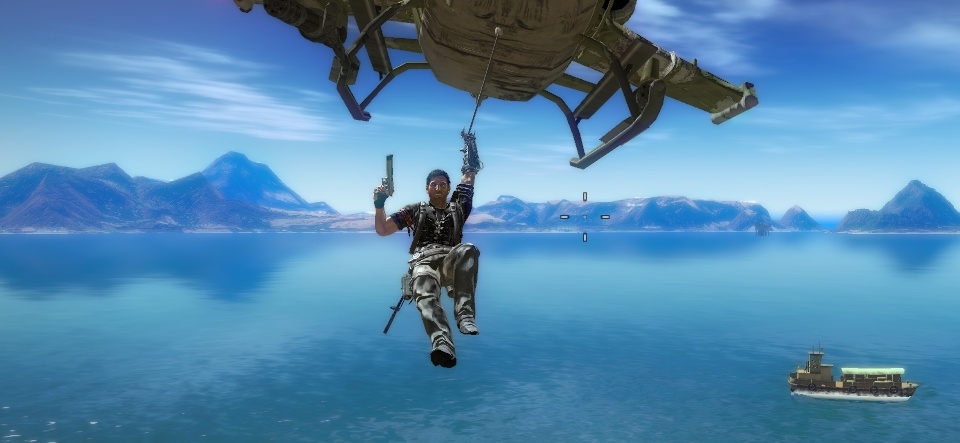
SAeN: Because of this picture and many of your grappling hook themed enthusiasm, I will definately be buying this game!!
| ||||
|
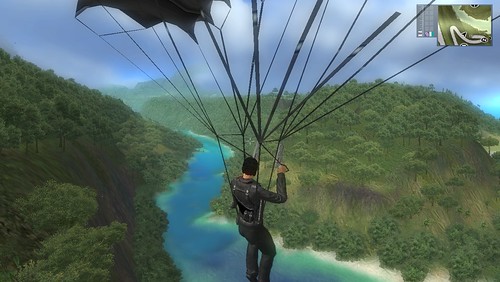
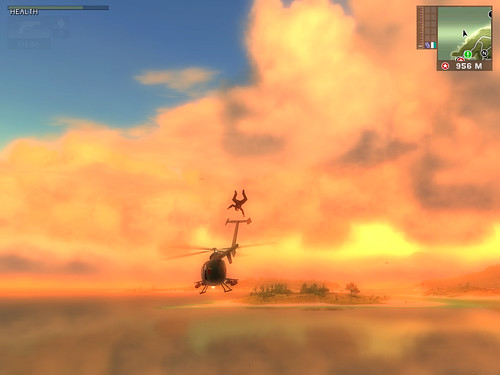
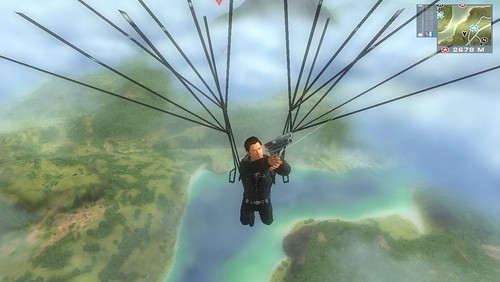
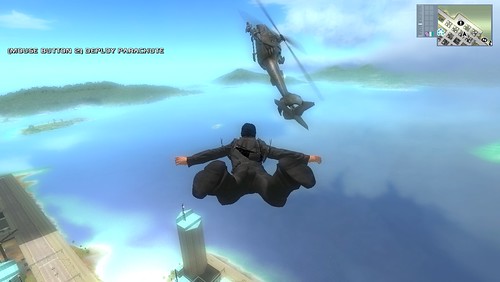
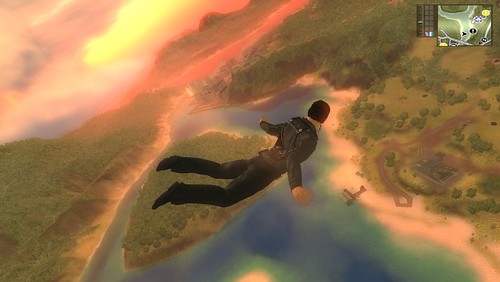
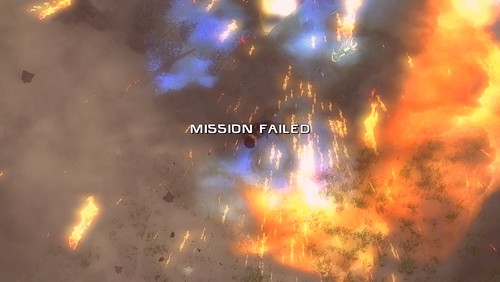
I don’t think I wrote about it here much at the time, because it wasn’t publicly out when I was really into it, but Just Cause is one of my favourite games. Open world games don’t seem to have much trouble making a great open world – most of the big ones like Oblivion, Far Cry 2, World of Warcraft and GTA IV are all wonderful places I want to spend time in. The difference with the islands of Just Cause, which are as pretty and inviting as any of those, is that you can fling yourself at them. I’d just finished a mission, one which left me exhausted and bleeding on a beach miles from anywhere. The next place I needed to get to was on another island entirely, and there were no boats or choppers nearby to hijack. So I called the agency to have them drop me off a motorbike. When it came, airdropped unceremoniously in a heavy wooden crate, I ignored it and fired my grappling hook at the agency helicopter that had dropped it off. It’s one of the only things in the game you can’t hijack, but there’s no rule against hanging on to it. I reeled in and took hold of a tailfin as it thundered off – in completely the wrong direction. It lifted me all the way over an inland mountain range, through a lashing storm, up through the cloud layer (the clouds you see in the sky can all be reached), and into a grey limbo where the island below was just a dark smudge. I let go. Just Cause is the only game I know with a key for “I’m not falling fast enough, make me fall faster”. The heights involved are so sickeningly vast that even freefall can take minutes to drop you. So you can make yourself more streamlined, steer with your body, and choose when to open – and when to suck back in – your parachute. Mixing them to toy with your momentum vector gives you a wonderful freedom in that massive cold space, and I had so much height to work with that I was able to steer all the way back to the coast, then over it, then to the next island, and finally to my objective. I like to come in fast: chute open, but angled downwards to drop through the air; then pull up at the very last minute and spin 180, toes whipping the shrubs. Finally I cut the chute and land in a commando roll, stand up and punch my boss in the face. This may be why he goes AWOL in the sequel. People really didn’t take to it, not even most reviewers. EGM complained that it was ‘unrealistic’ (…), Eurogamer said the terrain was ‘uninteresting’ (!), and GameSpy claimed Saints Row 1 gave it ‘a wedgie in graphics’ (;). Other than the glitches (which seem minor on PC) and the rudimentary shooting (which would be a problem if it were a hard or large part of the game), most complaints seem to stem from the assumption that open world games are obliged to provide five to twenty times as much hand-scripted content as linear ones. Certainly some of them do, but the sense of entitlement baffles me. They don’t cost more, and they seem if anything to be more replayable rather than less. I’m writing this because I’ve stopped playing it, and I’ve stopped playing it because a mission was pissing me off. It has some sublime ones, and the last may be the greatest final mission I’ve ever played, but quite a few fall into obvious scripting pitfalls. My excitement about the sequel due next year is getting me thinking about what precisely they need to fix, because it’s not the weird quibbles its press critics decided to mewl about. Infinite helicopters. No good can come of infinite helicopters. If I try to concentrate on the objective, I’m constantly being shot at or rocketed and thinking “Fuck, I need to stop concentrating on the objective and do something about these infinite helicopters!” If I’m concentrating on the infinite helicopters, even perfect one-shot kills with a stash of limitless ammo doesn’t let me take them down faster than new ones arrive. Worse, it cheapens the value and significance of the most sacred bit of military hardware. Health. When fighting infantry, a trivial task for which you rarely need healing, healthpacks spew from them like medicinal pinatas. When fighting vehicles, which rip through your health mercilessly, there’s no reprieve. In multi-stage missions getting too worn down on an early objective can leave you incapable of proceeding from the checkpoint immediately afterwards. The risible regeneration system takes nearly a minute of utter tranquility to restore a useless 10% of your total health, and will never nudge it beyond that. Get on the gun, Rico! Hardly the only game to be guilty of these sections, but seriously, they’re so easy to avoid. It’d be great fun to grab a mounted weapon and tear through a huge army of pursuers if it were an option. When it’s forced, and the pursuers triggered by stage queues to show up in a convenient place for you to shoot, it starts to feel too much like a fairground ride. Get the truck to the waypoint in one piece! No. I’ll probably be back here adding to this list once I’ve got a few missions further in, but for the most part I’m having even more fun than I remember. If you’re tempted, it’s £9 on Steam and a Universal Resolution Changer lets you run it widescreen.
More Just Cause
| ||
Pentadact: If, like me, there's you get stuck on some bullshit bit and just want to see the rest of the mission, there's a Trainer here that works with the Steam version that binds F1 to god mode: http://www.cheathapp... ...p?id=21645
There don't seem to be any ordinary cheats. | ||||
![]() I’ve just declassified my Just Cause shots, since the game is long out. The plot of the game is that the CIA want to overthrow the government of this island nation to destabilise the area and allow them to put their ruler of choice into power. Their modus operandi for this is to drop you, from a plane. They figure you’ll take it from there. You literally do – you control that skydive, and everything from that point on, and you’re basically incredible. I’m riding a weaponless civilian jet-ski along a winding river with three gunboats following me, three helicopter gunships slamming missiles into the water all around, and the military about to dispatch fighter jets to take me down. I have a grappling hook. And these guys are so, so screwed. In a minute or two everything is a flaming wreck except the best helicopter, which I am flying, at an altitude of five inches, in pursuit of a police boat that’s arrived to investigate the carnage. I pull up, jump from the cockpit to the boat, and kick the cop out of it as the chopper doubles backwards and crashes upside-down, blades-first into a group of troops lining the coast to get a shot at me, and I zoom off into the open ocean. This is normal for a Tuesday.
More Just Cause
| ||
What’s Wrong With Just Cause?, by Tom Francis: [...] don’t think I wrote about it here much at the time, because it wasn’t publicly out when I was really into it, but Just Cause is one [...]
| ||||


Subscribe to comments
Plan B
Exploded
Don't Make Me Play Football Manager

Tim Edwards
Craig Pearson
Graham Smith
Rich McCormick
Richard Cobbett
Chris Livingston
Jon Blyth