TOM FRANCIS
REGRETS THIS ALREADY
Hello! I'm Tom. I'm a game designer, writer, and programmer on Gunpoint, Heat Signature, and Tactical Breach Wizards. Here's some more info on all the games I've worked on, here are the videos I make on YouTube, and here are two short stories I wrote for the Machine of Death collections.


Search
My Favourite Disaster
Back from further secret adventures in the world of exciting things, spent thirty-eight hours on planes this month, tired in a way that sleep won’t fix. It’s breaking season again: came home to a soaking kitchen, TV blew up, network down, new bike tyre immediately flat, PC unupgradable, and laptop took two days to rescue from a series of disasters. The main reason I’ve done so much travelling is that the game broke during my first trip, and couldn’t be repaired for two weeks.
My favourite disaster was when finally managing to get an operating system on my laptop left it unable to recognise its own network card. I had the driver – a 612KB file – on my PC, having found and downloaded it with surprising ease. But I lost my wonderful 4GB USB drive on my way back from my last trip (whoever finds it will have the magnificent ending scene of Portal completely ruined for them by the movie found thereon). I’d used up all my blank CDs burning duff copies of various operating systems after each disc – legit and otherwise – seemed to have at least one essential file corrupt. I had blank DVDs, but the laptop only has a CD drive. I had a floppy disk, and the laptop even has a floppy drive, but nothing else I’ve owned in six years has. I had SD cards, but no card reader. I had a camera that takes them, and the USB cable to connect it, but Windows XP won’t let you write files to my camera because Windows Media Player doesn’t think of cameras that way.
I also had a SIX GIGABYTE MP3 player, but it’s long since stopped working in USB storage device mode. This leaves only Media Transfer Protocol mode, the same infernal madness that dictates that a camera is not a device to be written to. It admits that an MP3 player could conceivably need to receive files, but stops you if you attempt to transfer anything it wouldn’t know how to play through speakers. At this juncture, after curtly informing you that what you’re trying to do is idiotic, it presents you with three options: Skip, Skip All, or Cancel.
This is perhaps the single dumbest problem I have ever encountered. I could almost write out a file of that size in a hex editor if I had a few hours longer. So I used my usual method of getting to the heart of how stupid stuff works: if I was an utter idiot, how would I design this? Well, I certainly wouldn’t actually verify if anything was really a playable music file, I’d just see if the extension was .mp3 and throw a hissy fit if not. By the same logic, a clever man like Tom could easily bypass my angry stupidity by just renaming any old file to MP3, however unmusiclike, then naming it back when successfully transferred.
This is how I came to coin a catchy little ditty called R34071.mp3. It goes a little something like this – and please do sing along if you know the words:
Well, I’m sure you know the rest.
Quick BioShock Warning
If you’re anything like me, the first thing you do with a newly installed game is delete the interminable publisher logo movies. You’re told BioShock is by 2K three times each time you start it, and have to read unskippable copyright blurb in four different languages – so much of it they have to split it across two separate unskippable screens.
You can delete them with BioShock – the movie you hate is first alphabetically in the Content/BinkMovies folder, and called 2KG_logo_720P.bik. But for God’s sake, open that folder in a very small Explorer window. Remember those three words I was talking about, the ones that ruin the game? Two movies lower down in that folder are called exactly that. Genius.
Also, if you install the game on one machine and don’t need it there anymore, uninstall it properly – especially if you’re going to reinstall Windows or format the hard drive. Each time you install it uses up one of your Activations, and you’ve only got two. Each time you uninstall it gives you that one back. So if you just delete the folder or reinstall Windows, you lose that Activation forever. Genius.
On the plus side, I hear the game’s quite good.
Rock, Paper, Shotgun
From a new gameblog entirely by people I happen to know. It will fail and explode and probably cause a quite serious outbreak of head-cancer, of course, because it’s not PC Gamer – the best and only worthwhile achievement of mankind so far. But still, I have to admit that’s a pretty good opening line for an article entitled Horrible, horrible game still clings to life.
British Airwaves
You’re supposed to feed a cold and starve a fever, I think, but I’m not sure what you do if you have a cold and a throat so sore that you can’t swallow food without hitting something and saying “Motherfucker!” afterwards. So far I’m dosing Halls, Lockets, Oraldene, 300% of my RDA in Vitamin C and Zinc and 200% of my RDA in sleep – to no avail.
I’m blaming British Airways, this time, for sitting me next to a door. a) Why would you put an Expensive Class seat somewhere too cold for human survival even under a blanket with the heating on maximum, and b) shouldn’t the doors on a plane be, like, airtight? Might my freezing be a symptom of a rather more serious problem at umpteen thousand feet? The two things BA can’t seem to get right are sending your baggage to the same hemisphere as you and an in-flight entertainment system that actually works. If they’re also failing to maintain hull integrity, I’m not sure they even qualify as an airline anymore. ‘Airborne torture wagon’ might be closer.
Are flights in one direction faster than in the other direction because you’re so high up that the air you’re flying through isn’t quite rotating on the Earth’s axis as fast as the ground? Because that’s kind of awesome if it’s true.
Anyway, since actual remedies aren’t working and pretty much everything causes an equal amount of pain now, I’m coiling up with chorizo cheese on toast, a flagon of coffee and a Damages triple-bill. I’m slightly gay for Tate Donovan.
BioShock Review Review
The issue of PC Gamer with my BioShock review in is now on-sale in England. I wrote it mostly with lunatic fans like myself in mind, so I don’t spend a lot of time saying what really should be the first thing you say about BioShock: holy shit! Someone made a game about a subaquatic capitalist utopia for the intellectual elite! And it’s going to sell? This is a game in which you have to know some of the history of Versailles to understand one of the villain’s insults to you.
There are ways in which BioShock does more with its subject matter than any other game I can name, but mostly it’s just amazing to have something to sink your brain’s figurative teeth into. It has ideas. There are themes. I think I even saw a paradigm.
I’ve started capitalising the ‘S’, you’ll be riveted to hear, because a) it’s correct, and I’m a fan of correct, but also b) it’s very System Shock 2. You can even draw a line from each of Rapture’s districts to each of Shock 2’s decks. They might not be able to say so legally, but there is a Shock series of games and this is one of them. The best, in fact.
I was slightly bemused when I first heard that they wanted to make a game set somewhere “more interesting than a spaceship”, because Shock 2 did such an extraordinary job of making that ship a vast and exciting place to explore. But yeah, I get it now. This is an order of magnitude more artistically exciting.
I’m not talking about the bits where you kill children, because they’re not very good and they don’t need to be. Everyone will fixate on them forever and ever and it will be boring and terrible and that’s a shame. They’re not important, either emotionally or mechanically, and the game has so much more going on that is provocative and brave and weird and brilliant.
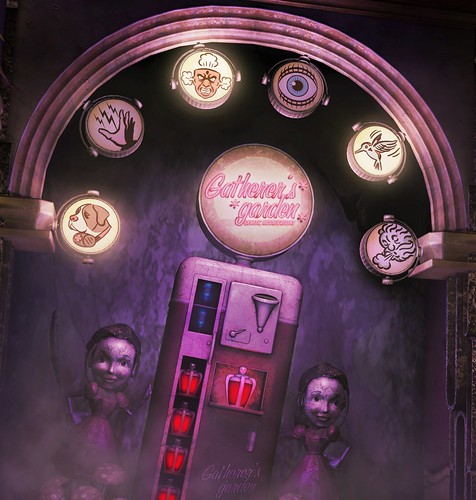
The lunatic fans seem to be satisfied, by the way – although they frantically crave documentation of every microsecond of the infanticide. And one called me a ‘filthy worm’ for giving it a score as low as 95%. While I was away in France last week, the first copies were delivered to subscribers, and one guy on the official forums got to be a mini-celebrity for a few days by being the only person who’d read the first ever review of their holy game. People grilled him for info and implored him to type in the first few sentences. I love being a part of something that inspires that level of excitement, even if I’m just riding Irrational’s coat tails.
There’s a line in my review that starts “So kindly avoid any…” I would just like to say, for the record, that this line originally read slightly differently, and you will probably be able to guess precisely how once you’ve completed the game. It was a very obvious and weak in-joke that hinges on something enormously spoilerific but invisible to the uneducated eye. I couldn’t ask Tony to make sure he kept it intact when he was sub-editing my review because it would have entirely ruined the game for him, so I’m just going to have to ask you to come back here in a month, sneer slightly at my failed attempt at a bad joke, then switch your neural interface back over to whatever Zero-G Hyper Sports event the future will presumably be full of.
Gollum Beat Box Like You Never Seen
|
Yo my name is Gimli and I’m a fucking dwarf Now all you Boffins and Bolgers, Bracegirdles and Proudfeet Yo, I’m harder than a Mithril coat |
The Machine Of Death Winners
The winners have been announced for that short story competition I entered a while back, for a collection of stories based around the idea of a machine that can tell you how you’re going to die. They all sound extraordinary. When the winner-notification date came and went without e-mail, I tried and failed to imagine what the winning stories were like, and the selections really show how small-minded I was being.
One of these is about paramedics in the future. One’s about a magician. There are stories about class, revolution, family, the third world, and one that’s just a series of personal ads. And one, inexplicably, is mine. They told me two or three days after I was entirely sure it had been rejected, which I can now confirm is the best way to win something.

The editors – Ryan North of Dinosaur Comics, David Malki of Wondermark and Matthew Bennardo of the world – had planned to self-publish the collection, but have apparently had some interest from actual publishing houses since. So I imagine they’re going to shop the manuscript around for a while and see if someone who could get it out to more than just Amazon.com will snap it up.
Either way the text will be free online, and eventually as an audiobook – sorry, podiobook (spit!). On my contract I waived the right to insist on reading it myself, because I couldn’t decide whether it would be more exciting to be on an audiobook in person, or to have someone good reading my thing. Instead I’m going to audition to read my own, and let them decide. If my voice really is as grave and dull as it sounds to me, hopefully they’ll tell me so and get someone else to do it. I’ve shot myself resoundingly in the foot, of course, by implying my narrator is North American.
What I didn’t know until that announcement post was that all three editors of the collection are including a story of their own. Since Ryan North basically invented a new grammatical logic for the English language in Dinosaur Comics, this is rather exciting. Inevitably his story has the best title of the lot – MURDER AND SUICIDE, RESPECTIVELY – and an immediately enticing concept: two scientists realize that the Machine may allow them to send messages backwards through time.
These three are in addition to the 29 chosen submissions, from 681 entries, so the final book with be 32 stories of something like 4,000 words each. Mine is one of the longer ones, at 6,600, and earned me the king’s ransom of $45, so I’ll be quitting my day job shortly and vacationing on the moon.
That fee is only for the First English Anthology rights, so I can still keep it online here, and will do so until the book itself is out and the whole text of that is online – when I’ll probably link to that instead. I’m imagining it’ll be something like a year before that actually happens, which sucks because I badly want to read almost all of these.
System Failure
Preface: I need to get this one out of my Drafts folder before I resume the positivity. I wrote it a while ago, at my parents’ place, in such a fury that I barely remember typing a word of it. To break up its somewhat critical tone, I have inserted some of my Eve Online screenshots. Here goes:
My Gran knows a lot about wood-working. She likes wood, she likes working with wood, and she likes things made of wood. My friend Steve knows a lot about bikes. He likes riding bikes, he likes tinkering with them, and he even seems to like trying to explain to an idiot like me which one I should buy.
I know a lot about computers. I hate computers.
I’m part of one of the first generations to grow up with them – we’ve had at least one in the house as far back as I have memories, and I’ve had my own from secondary school onwards. So I’ve sort of hacked away at the most maddening idiocies that would normally get in the way of the things I use them for, but I still don’t think a forty-eight hour period has gone by without one of them making me swear, and I’m extremely difficult to anger.
The problem is that they don’t occur naturally, they have to be built. And they have to be built by people who are very intelligent in precisely the way that typically only people who are hopeless at understanding people are. Then they have to be used by people.
It’s incredible that there’s even such a topic as ‘usability’, laughable that it’s a relatively new one, and embarrassing that we haven’t actually done anything in it yet. Things like iPods are still seen as examples of it, which makes this era a lot like the one when fire was considered technology.
Linked computers are the single most important non-medical advancement mankind has made since the wheel, which I’m increasingly of the opinion was a mistake (except perhaps for bikes, which have broadly seen a net benefit), and we haven’t got round to figuring out how to make them usable yet? Usable. As in, so peope can use them. What have we been doing?
\i tend to notice what’s most heinousy wrong with computers when \i have to use someone ese’s to show them how to do something. \the pacement, for exampe, of the forwards sash key on a \toshiba \sateite \pro\; precisey where the shift key is on every other computer in the word. \or the fact that the ” key barey works on this particuar machine.
I was trying to make BBC website’s radio work on my mum’s, this, laptop. I fixed the first problem in three seconds – the volume was set to zero – but it’s four hours later now and I still haven’t actually managed the broader task.
And it’s worth saying that no-one ever tells you those concentric ellipses next to the clock represent a speaker rather than the Death Star (which they much more closely resemble) and that they summon no, not the speaker volume (that would almost make sense (spit!)) but the Windows volume, which is a range of meta-volume sliders that govern and multiply with all other volume settings, of which there can be up to five nested levels at any given time, sometimes in geometric and other times exponential proportion, and that they produce two different interfaces for these meta-volume sliders depending on whether they were single- or double-clicked, meaning that attempting to activate the double (which appears in a conventional window format) frequently creates an instance of the mini-interface triggered by the single (which manifests itself in a narrow, windowless overlay that steals focus but is not recognised by the operating system or Start Bar as an application, and presents the user with no obvious way of dismissing it, and which frequently encounters an unhandled exception that means it can’t be dismissed), sometimes followed by a second instance, sometimes moving to follow the cursor as it clicks again, sometimes actually blocking the second click, and jumping the volume to zero in doing so – quite often (and in this case) the very misconfiguration you are attempting to reverse.
When I said that was worth saying, of course, I had imagined I would be able to do so in fewer than a thousand words and four-hundred overlapping nested clauses.
Clicking the Listen Now link from the homepage of a BBC programme launches a new window which immediately notes that you do not have the RealPlayer plugin installed, which I took to be a compliment – the Windows equivalent of saying “Oh, you’ve lost weight!” or “So you finally realised puffer jackets weren’t even cool seventeen years ago?”
Mostly, I admit, out of disbelief. RealPlayer went out of fashion on websites to the extent that fascism did in Germany, some time before puffer jackets outlived their fad. Five years before their invention.
But this was not my own computer, and I thought there would be no harm in installing a small plugin which I happen to hate. I committed the very fallacy that is responsible for the ridiculous state of all computer software today – I thought something would be ‘good enough for normal people’.
If I were King God of Earthtopia, supporting RealPlayer would be a criminal offense. The punishment for requiring it would be watching your children die. So discovering that my technical savvy wasn’t actually up to the task of installing it, I couldn’t entirely suppress a noise that cause my mum to immediately ask what was wrong.
“There’s a picture of the download link.”
A picture. The BBC whisk you to their Help page, which is really a FAQ, rather than pointing you to the plugin, and then when you finally find the question that relates to the problem they already know you’re having, it has no link to the piece of software you need. Instead, it offers you an installation guide, the first step of which is to install the software. To illustrate how you do this, they show you a picture of the download button that you will find four pages later, just after step – and please excuse the large font you have by now already seen coming – FOURTEEN.
The picture is not a link. It is a picture of a link. It is a picture of a link you must click to complete step one, but which you cannot click until you have skipped steps 1-13, at which point it takes you away from the guide entirely. Nevermind why, how, in all conscience, there can be a FOURTEEN step process to install what PC World Magazine rated number two in their worst 25 technology products in the history of human civilization, in order to listen to the fucking RADIO; something people have been doing since before the FIRST WORLD WAR.
No! Actually, do mind that. Mind exactly that. Mind it furiously, because putting up with this shit is exactly the reason we have to put up with this shit.
Here’s the reason this matters: if you’re responsible for a feature of a site which, over your site’s lifetime, causes five million visitors five minutes of frustration, you are responsible for a lifetime of pain. That’s not a figure of speech, I actually worked it out – that’s seventy years of torment. If I were in charge of a team making a website, I’d have the designers watch the user tests with their hands splayed out on a table, and every time someone so much as frowned, I’d smash one of their fingers with a claw hammer six times. There’s no maths behind that figure, that one just feels right.
I didn’t read it, I skipped to the download link for the thing I didn’t want, it downloaded, I ran it over Internet Explorer 7’s apoplectic objection to me running a file I deliberately downloaded (to be fair, on this occasion it had a point), and it ran the RealPlayer downloader. This is an application consisting of a single blank horizontal progress bar that never progresses, a pause button that doesn’t do anything, and a mysterious ‘down’ button that depresses slightly when clicked. By flatly and categorically not working even a little bit, without explanation, it proves itself far superior to the program it’s trying to download. A Real program that doesn’t do anything is a relief on the scale of a cancer that doesn’t do anything – the word is not ‘malfunctioning’, it’s ‘benign’.
It’s not good enough for ordinary people, because ordinary people is everyone. Developers assume, when so few people seem able to intuitively understand their products, that people are stupid. In response, they hide the advanced features in future versions, insert big, colourful images, constant pop-up windows that try to explain what’s happening, and extensive help files. And of course, even fewer people understand this newer version, because hiding complexity adds a whole new layer of complexity.
Since DOS, computers have been getting harder to use. If you use XP, the easiest way to work with it is to also install Google Desktop, and use its quicksearch function to just type in the name of the thing you want to open or run, and press enter. Even if you’re an ordinary person. My gran can type ‘calculator’ more quickly than she could locate and click on it in the Start Menu. I can type Firefox faster than I can click on its quicklaunch icon.
Writing the name of the thing you want is dramatically quicker, more logical and easier to do than stroking the narrow slats of a clickless location-sensitive nested lateral hierarchy of hundreds of wildly diverse items that are categorised not by function, not by type, not even by name, but alphabetically by the name of the company that published them – not even the one that made them.
A search box is the low-water mark against which all interfaces should be judged, because it’s a complete lack of interface. And yet so far, we’ve yet to come up with anything more efficient or self-explanatory. It’s actually quicker for me to find something on the internet by typing it into the Firefox address bar (which Googles it) than it is to get back to it again via my bookmarks.
Windows Vista makes an almost sane gesture by adding a search box, but again it’s a step back: slower, harder to get to, harder to select a result from and limited to certain folders. Right now the only people even breaking even on an interface front are Google, who don’t even make operating systems, just by adding in the crudest and most basic possible interface concept into the OS they know we all have to put up with. It’s only by comparison to the excruciating insanity of modern interface design that it seems like an actual achievement, and it’s virtually the only thing we’ve got that just about qualifies as usable. Everything else is a fucking disgrace.
The Order of the Phoenix
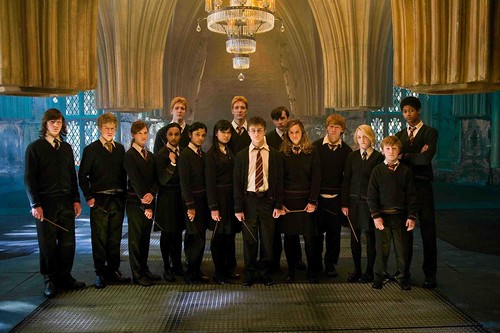
Right, that’s it. If Transformers isn’t any good on Sunday, I’m giving up on fun-but-dumb films altogether – I no longer enjoy them. I didn’t like the latest Pirates of the Carribean, I hated Die Hard 4, and last night even Harry Potter left me cold. My brain just doesn’t have enough to do during these, which is really saying something given that I enjoyed Gerry, a film where the memorable quotes page on IMDB constitutes the entire script, and the only two characters have the same name.

So I either think about other things entirely (is this seating arrangement socially optimal? Almost, I decided), or pick holes. That CGI object isn’t correctly synced with the actor’s hand. The next line is going to be “Something to fight for.” Emma Watson can only act during even-numbered minutes of the odd-numbered Harry Potter films.
When I read the same story in book form, I cared about everything. And really, it’s a story that suits cinema better than literature in a lot of ways – the fizz and crackle of wizardly battling comes across very poorly in text. But this director’s concept of being faithful to the book seems to be checking all the subplot boxes, which is impossible to do well in under six hours. So the three most affecting elements of Phoenix are all glossed over with almost comic brevity. Those being:
-
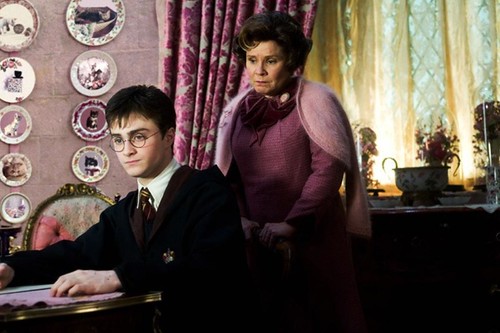
Delores Umbridge’s torture: I thought the actress here was great at portraying her syrupy strain of institutionalised evil, but the real potency of the character comes from the horror of what she makes Harry do. He has to claw her words in his own flesh over and over and over again every night, writing in blood over his scar tissue before it can heal. It’s the repetition that’s galling – that’s why it’s such a wonderfully fiendish play on the familiar punishment of ‘doing lines’ – but in the film we see him do it once. Misses the point, dissolves the horror, defangs Delores.

- Neville Longbottom becoming more than comic relief: after mocking his idiocy for four whole books, Rowling adds a streak of genuine tragedy to Neville, and a sad little stirring of redemption. It’s an easy pluck of your heartstrings, but a resounding one. Here’s how this story is told in the film:
(Neville Longbottom is standing in front a wall looking at a newspaper clipping that shows a photo of his parents. Harry joins him)
Neville: Hi Harry my parents were killed by Bellatrix LeStrange after she tortured them for information I’m proud to be their son but worried that I won’t live up to their good name thanks bye.
Fin
- Harry’s increasingly conflicted relationship with Snape: the entertaining thing about Snape as a villain is that he isn’t one, he’s just an extremely unpleasant good guy. Or so Dumbledore insists, and since he’s virtually God in the Harry Potter universe, we tend to trust his word over even Harry’s judgement.
In Phoenix, Snape is the only one able to teach Harry to defend his mind from Voldemort’s invasive telepathy, an arrangement they both resent enormously. But also a great device not only to force Harry to see Snape as a good guy, but to let both of them find out the truth about each other.

By repeatedly invading Harry’s thoughts, Snape quietly has to face that most of his conspiracy theories about Harry have been wrong. But when Harry inadvertantly gets into Snape’s mind, he has to face that more or less every disparaging thing Snape has said about Harry’s father is true, and a lot worse besides. This is a huge deal, a genuinely quite brave twist, and the most devastating thing that’s happened to Harry so far. His only reason for enduring the increasingly horrible things life puts him through is this dream of living up to the example of his parents, and avenging them.
We do get the moment of discovery itself in the film, inside Snape’s mind, but it’s topped and tailed: it happens almost immediately after the lessons are started, so we get nothing of the way Harry and Snape’s relationship has changed, which is probably the most interesting thing in the book. And we get nothing of the aftermath, which is easily the most important thing in the book.
It feels like they think fans are more interested in seeing every subplot paid lip-service than in any of them being done justice. I could be entirely happy with a film of Phoenix that left out all three of my favourite things about the book, if it just did anything else well. If it just had some downtime, some of the day-to-day stuff that lets you get to like the characters before they get knocked around, I’d care.
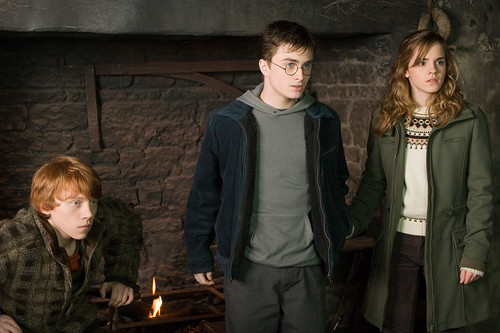
The fun of Harry Potter is never the plots, it’s getting to live in their world for a bit. It’s enduring the Dursley’s long enough at the start of each book to be relieved and excited to get back to Hogwarts and his friends. It’s butter-beer in Hogsmeade, non-plot-critical Quidditch. This ruthless, workmanlike cramming the films are so hellbent on is wrecking the magic.
Visually it’s marvelous; another adoring tribute to the universe that matches my imagination beautifully. The effects guys really do care about doing everything justice, and they’ve got the creative juice to manage it all and more. That just makes it more irritating that they’re still using directors who waste it incompetently, when in Alfonso Cuaron they’ve already found the guy who can give the rest of film the character its effects already have.
The Completist: Tribes: Vengeance
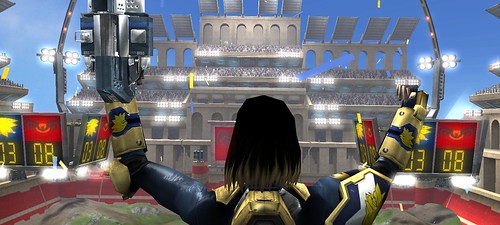
What I thought at the time: Great, but merely great. It got eighty-something in our mag (Tim reviewed), and I remember thinking “God, I love eighty percent games” as I jetted and ski’d around the enormous levels. The Grappling Hook level annoyed the living fuck out of me, though, to the extent that I stopped there and didn’t play it again for three years.
What the world thought at the time (paraphrased): The world was unavailable for comment since no-one in it actually bought Tribes: Vengeance. It went vritually unmarketed, so only the Tribes hardcore actually bought copies, which was kind of a shame because, by putting enormous effort into a lengthy, complex, story-driven single player campaign, it was very obviously designed to court everyone but the Tribes hardcore. They hated it.
What the world thinks now (paraphrased): The world is unavailable for comment as its populace have either a) never heard of it, b) forgotten about it entirely, or c) intentionally erased it from their memories to preserve their fondness for the original games.
What I think now: I liked it a lot more this time through, admittedly because I wasn’t above using a level skip cheat to avoid fiddling around with the dismal grappling hook level, and to retain my sanity when I lost yet another hour’s progress due to the COMPLETE FUCKING LACK OF AN AUTOSAVE. The ludicrous thing is, the reason I keep losing masses of my progress is that I like the game so much. I’m lost in it, so I’m almost never pulling back and thinking “This is a game, I need to save”.
It doesn’t even have a quicksave key. Instead, you have to pull out to a menu, select save, then select “New Save Game”, whereupon – I kid not – it asks if you want to overwrite “New Save Game”. It’s not really an option, it’s a dummy savegame they put in there that gets recreated when you save over it.
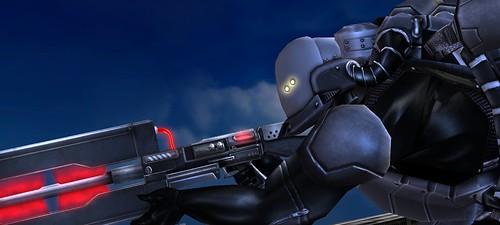
The thing I wish everyone would copy: Skiing! We have games with jetpacks – though not enough by anyone’s count – but we badly need more that combine your short-lived skyward thrusts with the ability to curl that gravitational potential round into blindingly fast lateral motion by angling your descent along inclines. It’s a thrilling, elegant and endlessly satisfying mechanic. Even on the last level I was amazed by the dizzying speed I could pick up by playing off the shape of the land.
Best bit: It’s partly that, but more specifically what that leads to in the context of a single-player shooter. Because the levels are enormogasmic, you have some time and distance to plan your attack. But the main thing you’re planning is not which weapon to use, where to throw a grenade, but the rollercoaster undulations of your blistering route through the area.
“If I jetpack over that ridge, I can land on the incline and ski all the way down to the facility, and hit that lip at the bottom to launch over that water-tower, take out the turret, and still have enough jetpack juice to blast up to the mountains on the other side of the valley to ski back for another pass.”
I got to the stage where I could execute all this without hitch almost instinctively, leaving my higher brain functions free to handle the shooting as I shot by. The centrepiece weapon is the Spinfuser, which is like a lightweight rocket launcher except that your missiles inherit your own velocity. That means that you have to lead to compensate for both your own movement and that of your target, so nailing five guys as you slide by at eighty miles per hour does genuinely need some brainwork.
I don’t think I’d like a game that forced you to conduct that kind of mathematics in the middle of an N-like momentum manipulation across a 3D landscape, but I love that there’s a game which lets me, and rewards me.
How cocking hard is it? Not too bad, but the challenge has its minor frustation factor magnified a billion times by the no-autosave thing. There’s the odd inordinately tough boss fight, some of them unexpected, and the prospect of repeating the entire preceeding level in order to take another whack at one of these caused me to level-skip to the victory cut-scene once or twice. I am not ashamed of this. Irrational should be.
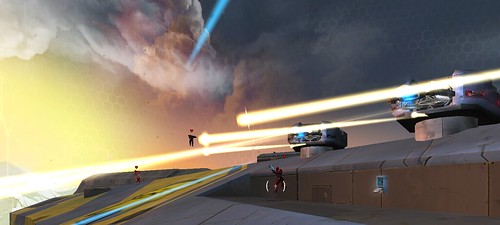
How long is it? Long. It feels super-epic, but in fact it’s merely long. It’s an utterly absurd structure – at various times you play a princess, her daughter at six, her daughter in her twenties, her daughter’s boyfriend, her daughter’s boyfriend’s killer and even your own killer. By the end of it, even though precious little of the dialogue and precious few of the characters have been even remotely good, you’re so exhausted by the sheer amount of plot you’ve lived through that you can’t help but feel rather satisfied.
Jumps the shark: Guess what? The grappling hook level. But not just because of the grappling hook. This is a level where you play a six year-old girl, piloting fighter jets and mowing down legions of trained soldiers. The problem with the grappling hook, by the way, is that their coders weren’t clever enough to work out how to make it wrap around obstacles that get in the way of the line, so when you grapple onto the ceiling or a high ledge, the challenge is to make sure your lifeline doesn’t brush some light fitting, skirting board or defect in the wall, or it will instantly vanish and you’ll plummet. It’s all the less tolerable because an Unreal Tournament player modded in a grappling hook with this feature implimented beautifully, and it took him all of a few afternoons. That’s the same engine.
What’s the end like? The penultimate level is really good, as mentioned, and entirely true to what made the bulk of the game great. The final one is a boss fight with someone who seemed to me to be a fairly minor character, and it’s pretty unremarkable. But it wins big points for a) not being at all frustrating, and b) being set above the clouds against a spectacularly beautiful sun. It’s one of the few games that ends in a place that feels like an appropriate place to end. It’s a game about flying, and you finish it higher than you’ve ever been before.
What’s the ending like? Surprising, actually. You never get to kill the real villain of the piece, she gets away scott free. It would almost be noir if the characters involved weren’t such hammy irritants.
Quickly
Before it vanishes from the dirty little corner of cyberspace that these legally questionable – but morally laudable – offerings dwell in, you must hear the latest Sissy Wish track on Fluxblog. Usually it takes me so long to realise how much I like a Fluxblog track that it’s gone offline by the time I’m ready to recommend it, but this one’s instantly great. I’d say more, but the truth is I’m still kind of a musical retard.
I don’t have the language to talk meaningfully about what songs are like or what’s good about them, and I frequently have to listen to something ten times or more before I even know if I like it, let alone how much. This is why people like Matthew Perpetua know I’m going to like something even before I do, and why my favourite tracks on a given album are only just now starting to line up with those of the person who recommended it to me five years ago.
I need to know stuff like, what’s the word for the rhythmic structure in the chorus to Yayaya? There’s something in the way she sings that string of nonsense that lets you know she’s just leading into the real line, and something about the systematic structure of the latter half of the couplet that leads logically up to the rhyme, even if you can’t make out the words. It’s logical to the extent that if you’d paused the chorus halfway through the first time I heard it, I’d still be able to hum the next bit for you. And I don’t know how, or why, or what you call that.
This is also why I get confused and scared when people I normally agree with suddenly hate a band like The National, who seem to be a) great and b) just like all the other awesome stuff we both like. I start to think it’s just been coincidence that our tastes line up a lot, and really they’re appreciating this stuff on a higher intellectual level I don’t understand, and I’ve just fallen for some crass commercial knock-off because I’m too stupid to know the difference.
The awful truth is that I only ever liked this artful, worthy stuff by smart, emotionally fractured geniuses because it sounded pretty and didn’t irritate me. And, of course, because not many people had heard of it.
Cloak And Tagger
I’ve had this vision for how music should be played in the future for ages now: tagged and sorted by mood, style, and speed. You’d click a few words – ‘fast’, ‘instrumental’, ‘electronic’ – and a playlist would be auto-generated from a randomised selection of tracks fitting all three criteria, weighted towards highest-rated and newest. Then you’d chuck it on your MP3 player and cycle downhill to work. Or I would.
I decided that since we’re already pretty much in the future, there must be something out there that already did this. The trouble is that searching for anything to do with tags and anything to do with media players gets you a billion results about ID3 tags, even if you add a “-id3”. Results are still talking about ID3 tags, they’re just not calling them that.
But I remembered Tony saying Winamp’s media library was really good. I’d already tried it, shortly after he said that, and hated it, since I didn’t really have a use for a media library beyond the simple big playlist I already have. And it doesn’t support custom tagging in the way I describe. But since I do already use Winamp for everything – and I just found a new skin that makes it look like the future – it couldn’t hurt to fiddle around and see how close I could get.
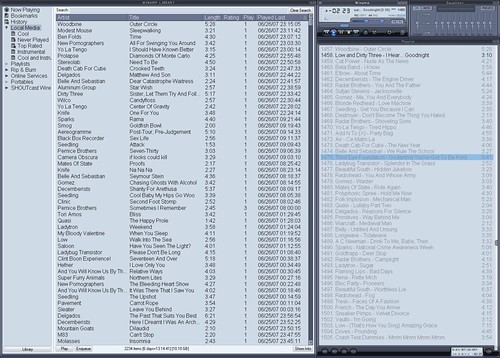
Very close indeed, turns out to be the answer. I can do all of what I mention above except the selection ‘weighting’. I can make the list only things with a rating of three or higher, or only things two weeks old or newer, but not a random mix weighted towards those things. Essentially I need a biased shuffle, and I don’t know of anything that can do that.
But custom tagging can be done, in a stupid sort of way. Winamp is nice enough to let you create your own custom ‘views’ – essentially filters for your music library. The default ones are things like “Never played”, and you can then drag everything that comes up in that View to the Playlist section and it’ll make a playlist of them. What you can do with the custom views is to specify that you only want tracks whose Comment field (a part of the ID3 tag) mentions ‘fast’ and ‘electronic’ and ‘instrumental’. Then instead of having an external tagging system that your media player would have to keep track of itself, you write your tags however you like in the Comment field, and they’ll stay with the file if you ever do change media players.
The stupid bit is that you have to create a new ‘view’ for each combination of tags you want to filter by, so it’s a few steps rather than just clicking a word. If anyone knows of anything that can do this better, do share.
I’m not trying to deconstruct my entire music collection into Pandora-like musical properties, I’m trying for a more teleological approach. That is, they’re tagged after what I might want to use them for. So there’s no “mild tonal syncopation” tag, because I’m rarely specifically in the mood for mild tonal syncopation, but there is a “wistful” one. There’s a “chilled” one for working to, and a “cool” one for playing games I’m good at to. Combinations thereof create a smaller playlist that more specifically nails the mood you want from the music, and you can even sort by ‘Times Played’ and select the fifty you’ve heard least often.
Yes, the theme for this week is Scientifically Quantifying Art. Because you can. The rest of the week I’ll be away quantifying a big chunk of art in a great deal of detail, and I look forward to not being able to tell you about it when I get back.
Gamespot Finally Do The Logical Thing
And start marking games out of nineteen. Nineteen.
The scale still goes up to 10.0, the stupidest number in the world, but no game is permitted to score less than 1.0. Reviewers can still score to one decimal point, but only if they want to give it .5. And if they do, it can’t be a 0.5.
One of the many, many things I love about this announcement is editor Jeff’s thinly veiled astonishment and disgust at the surreal new system. “While I’ll personally miss the ability to give games a 6.8, I look forward to eliminating quibbles about the quality differences between games that are only a tenth of a point apart.”
I agree. I don’t know how we ever worked out which was better out of 7.9 and 8.0. It was baffling. And they were out of ten? What is this ‘ten’?
“You’re busy. You don’t have time to stare at one game that got a 5.2 and another that got a 5.3 and puzzle out what the big difference is.”
It was the ULTIMATE MYSTERY. There was no way of knowing. Nothing short of looking at the score could get you that information.
“We’ve been working on this update for quite some time now…” Here, this is your first tip-off that your planned scoring system is insane. If a way of rating something takes “some time” to work on, that is because it is not in fact mathematics but rather some sort of beat poetry with numbers.
In case I haven’t made this clear yet, I loathe everyone’s scoring system except ours and those identical to ours. This is because I am numerate.
7.5/10 is a decimal atop a fraction and never made a lick of sense, but this is a country mile further from Sanesville Tennessee. If Gamespot give something 7.5 now, that’s not 7.5 out of 10. It doesn’t translate to 75%. This, honest-to-god, is the equation you now have to put Gamespot scores through: (G – 1) * 10 / 9 = S, where G is the Gamespot score and S is any kind of rational system.
I once came across a website that marked out of twenty, but allowed quarter-points. They come close – close – to being as dumb as this, but it’s that fatal 1.0 minimum that just can’t be beat. This is, officially, the stupidest scoring system on the internet. And I say that as a man who gave a film “Bat out of bat.”
Oh wait, it’s cool. Now they’ve got a medal for “Xtreme Baditude.”
I leave you with a Daily Show-style moment of zen that is at once beyond, beneath and beside parody.
“With fewer scores to choose from, our review team will be able to speak more definitively about games. By eliminating scores like 7.9, we’re no longer able to say “this game is almost great, but not quite. Now our choices will be to say “yes, this is a great game” and give it an 8.0, or say “this game is good, but not great” and go with a 7.5.”
Score: (1.0 – 1) * 10 / 9
The Completist: Far Cry
Feh, I had another This Month in Terrible written but I’m bored of Terrible now. Terrible is over-rated. As stupid as it sounds, I’ve actually been reluctant to post here because I didn’t want to interrupt the series with something else, but didn’t feel like checking over and finding images for the final post. So, new series!
Valve’s stats show that still less than half their players have made it through the four-hour first episode of their follow-up to Half-Life 2. Crytek reckoned around 20% of gamers would see the end of Far Cry, and on anecdotal evidence I’d put the actual figure at less than half that.
If I really like something, though, I play it to death, then start again and play it back to life, and then really just mess around with its limp and compliant body of work until I get bored. So I shall, from time to time, note my thoughts on how old stuff holds up as I replay it, what the ending’s like, and how cocking hard it was. First up, Far Cry:
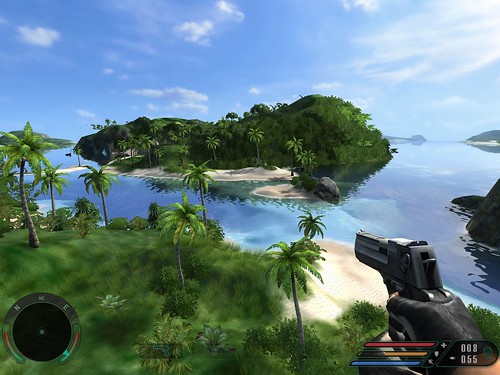
What I thought at the time: Brilliant! I knew the Trigen and indoor bits would suck, but I was expecting the game to degenerate into them for the whole second half, when in fact they turned out to be sprinkled bearably throughout. I remember playing River, one of the last few missions, about twenty times over, screwing it up each time but enjoying myself far too much to try and do it sensibly. I crashed boats into buildings, jeeps into the sea, boats into other boats, jeeps into boats, boats into people’s faces, and at one point a jeep into a helicopter. Sorry Bruce, I did it first.
What the world thought at the time (paraphrased): Brilliant! Unprecedented AI! Amazing graphicsability! Freeform gameplay! Ruined by Trigens!
What the world thinks now (paraphrased): Less brilliant! Everyone still loves the freeformness, but love for the AI has faded somewhat and the horrible Trigens and horribler last two levels have stuck in everyone’s minds.
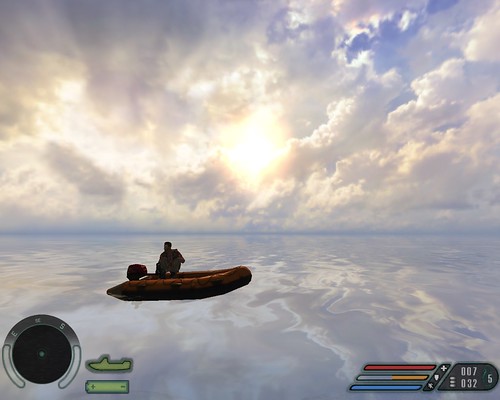
What I think now: More brilliant! I don’t know why, but the Trigens hardly bothered me this time through. I actually found them pretty scary – they pounce suddenly and unpredictably, and kill in one swipe, and take a lot of shooting, so you end up having a lot of moments where you only just kill them in time, causing them to fling their own limp, bullet-ridden bloody corpse into your face.
The two things that really stand up well today are the boats and the binoculars. Skimming that glossy rippled sea is pure joy, and crashing into a beach at a hundred and fifty miles per hour, flipping eighty foot into the air off a rock, is the only way to start a mission. At one point on Boat – a mission that has boats in it – I hit an enemy speedboat at full pelt, both of us firing, just as I took out their gunner. My boat hit the driver in the side of the head, threw me into the air, spun three times and landed the right way up in the water, just before I landed back in it and sped off. Bitches, I refer you to my wake.
The binoculars are The Thing I Wish Everyone Would Copy. In fact, new field:
The thing I wish everyone would copy: The binoculars. You scan an area with them and every enemy not behind anything very solid is highlighted, and their position is tracked on your radar from then on. It’s a level of intel most tactical shooters don’t dare give the player, for fear that he might be able to plan his attack, or enjoy himself. Situational awareness enables situational manipulation, and that’s where the fun always is.
Best bit: Oh, I wasn’t supposed to be talking about the best bits yet? Because that was the best bit.
How cocking hard is it? Not desperately, actually. Shameful admission: I actually played Far Cry on Easy mode the first time. I felt pretty smug about it, because everyone else was groaning about how hard it was even a third of the way through, and it gets a lot harder than that.
So I grit my teeth slightly when I committed to Medium this time through, but it was fine. I got through it without cheats and only mild frustration. I don’t think the end, which I’ll talk about in a minute, is as hard as people make out, it’s just frustrating. I died more times on the Boat level than on the last two missions put together, it’s just it wasn’t really my fault when I died on those, and I lost more progress.
How long is it? Fairly. You could cut out all the indoor sections – around 30% of the game – and it’d still be a good game-length. You should probably do that. They’re not terrible, they’re just no better than most shooters.
Jumps the shark: Not right until the end, actually – the mission where you start with an M4 and ten bullets, and there are a million Trigens. That was dumb. I didn’t cheat, but I did install the quicksave mod. I foxed that first Trigen by waiting for him to pass a boulder on his way to me, and passing it myself on the other side. PSYCH!
At that point I jumped off the waterfall, on a motorbike.
What’s the end like? After that you’ve got a drive through instakill magma rivers with five hundred Big Trigens – WEAK – an assault on a large complex full of well-armoured commandos without much health or ammo – WEAK – the fight with Dr Krieger, who is tough and irritating and surrounded by lots of guys and there’s nowhere to hide – WEAKNESS ITSELF – then the infamous dust bowl of four hundred Big Trigens – NOT AS WEAK AS PEOPLE MAKE OUT BUT STILL PRETTY GODDAMN WEAK GUYS.
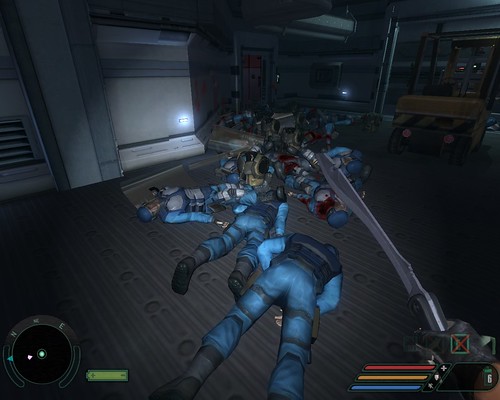
What’s the ending like? Abysmal.
Doyle: You don’t understand, Jack, they sent me, you can’t change the future!
Jack: Probably not! But I can make sure you’re not a part of it! LOL! (shoots Doyle)
Jack, that is totally changing the future you dick. Also stop talking like a barbecue salesman.
This Month In Terrible, Part 2: London Olympics Logo

It’s depressing to think that in my life, I will never write anything as funny as this logo. What the hell is it? The first thing I thought when I saw it, once I’d dried my eyes, was “What does the R stand for?” If the oblique angles that make up 95% of this image are supposed to represent the digits of 2012, what’s this:

It’s so typically British to have the only bit we could be proud of – that it’s in England – written in all-lower case seventies sci-fi script on the underside of something that might once have been a two.
Also hilariously dismal and quintessentially British is the ad they made to capture the spirit of these Olympic Games. It shows shining examples of the heights of excellence that the British spirit can achieve: a woman who’s managed to slim down to a mere fourteen stone, a disabled boy who can now ride horse without falling off more than three times, and a mother who, when she really tries, can cycle almost as fast as an OAP-buggy. It ends by speculating that she might one day be good enough to hand a bottle of water to a real cyclist. To sleep, perchance to dream.