TOM FRANCIS
REGRETS THIS ALREADY
Hello! I'm Tom. I'm a game designer, writer, and programmer on Gunpoint, Heat Signature, and Tactical Breach Wizards. Here's some more info on all the games I've worked on, here are the videos I make on YouTube, and here are two short stories I wrote for the Machine of Death collections.



Search
My Short Story For The Second Machine Of Death Collection
My second piece of published fiction will be out in July this year, as part of This Is How You Die: the second collection of stories about a machine that can predict your death. (My first was a story in the original collection, and you can read it here).
But! Editor David Malki is also Kickstarting a card game based on the same concept, and since it’s blown its funding goal by over 1000%, they’re releasing a few stories from the anthology to say thanks.
One of them is mine! You can read it now! Here it is!
It’s about a supervillain’s henchman tasked with the job of having their enemies killed in a way that doesn’t contradict their predicted deaths. It is called: LAZARUS REACTOR FISSION SEQUENCE!
If you can’t read it, go here.
Machine Of Death: Volume 2
I danced around the room like an imbecile when my story got into the original Machine of Death collection. I didn’t really know what it was doing there, next to all these awesome ideas, but I didn’t care.
Until it came out. Continued
The Podcast Of My Machine Of Death Story Is Out
The stories from the Machine of Death collection are being gradually released as a free podcast, a sort of episodic audiobook. Mine just came out, read rather excellently by Christopher Joseph. Warning! Strong language from the first word. Continued
STARVATION Review
I was a little dubious about this one, solely because one character refers to the other as ‘kid’ – something I’m not yet sure people do in real life. But it’s one of the most interesting settings for a Machine of Death story – one of the few that has the courage to put the machine itself well into the background of the world, and tell a story that is affected by it, but not about it.
It’s about two soliders, stranded on an island, who both know how they will die. One is STARVATION, the other is HOMICIDE. So the entire scenario is overcast by both men endlessly reconjecturing about how their personal prophecy could come true.
That makes it very tense at times, particularly since my twist-happy brain likes to spend its downtime trying to pre-empt every eventuality. But I can honestly say the ending surprised me, and in a way that made me the story seem smarter than me.
Machine of Death: a book that appears to be good so far. It’s now $18 from Amazon or Topatoco in the US, or in the UK for £11.50 with free shipping from The Book Depository. The whole thing is free in PDF form, and is trickling out steadily as an audiobook in podcast form. My story for it is online here.
ALMOND Review
A lab assistant charged with one of the first machines of death refuses to test himself, while everyone around him succumbs.
Pure pleasure to read – or in my case, listen to. It’s the longest story so far, but every time reader Kevin McShane (who sounds excitingly like Peter from Fringe) pauses for more than a second, you’re hoping it’s not going to end.
The whole story is a log, that rapidly devolves into a journal, written in a friendly and clear-headed style. The watch-word of this collection has been ‘refreshing’, and what’s refreshing about Chernega’s protagonist is his almost complete lack of curiosity. He’s curious about other people’s predictions, but he’s one of the few characters in the book so far not even tempted by the prospect.
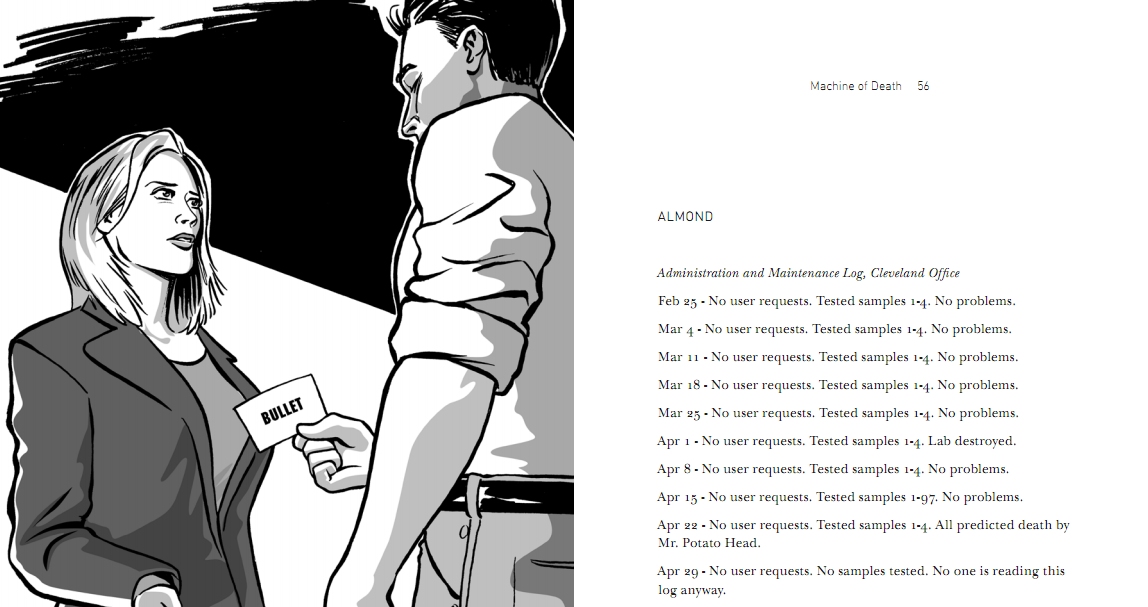
His diary charts the escalating public reaction to the machines, covering some of the same territory as my own, and I’m honoured they didn’t just scrap mine when they read this. ALMOND plays much more with the machine’s enjoyably sinister ambiguity – when it starts giving more than a few people GOVERNMENT, you know something interesting’s about to go down.
Some predictions are clever enigmas that are unraveled during the story, others are unexplained and seemingly unexplainable, and others seem to be openly fucking with you. That’s important, because the tension the story builds hinges on the narrator inferring a personality to the machine – one that becomes increasingly infuriating to him.
It has a punch, but doesn’t conform to the usual twist-story structure: the set up is almost immediately before the payoff, which prevents it from risking anticlimax. The voice, humour and escalating intrigue don’t need a giant question mark hanging over them to keep the story compelling throughout.
Machine of Death: a book that appears to be good so far. It’s now $18 whether you buy it from Amazon or Topatoco, and I think Topatoco have faster international shipping. The whole book is free in PDF form, and is trickling out steadily as an audiobook in podcast form. My story for it is online here.
TORN APART AND DEVOURED BY LIONS Review
An insurance salesman’s prediction turns his life around.
Refreshingly unmopey, nonjudgmental and un-non-funny. This is an exploration of the positive impact a prediction could have: not by implying a long and happy life, but by implying a death so exotic you have to assume things are going to get more interesting from here.
That’s really all there is to it, but it’s witty, fun, breezy and explores its concept with an infectious curiosity. The author is clearly a funny guy with a great writing voice, and he lets a little of it seep into every character. In a short story, that doesn’t hurt.
Machine of Death: a book that appears to be good so far. It’s now $18 whether you buy it from Amazon or Topatoco, and I think Topatoco have faster international shipping. The whole book is free in PDF form, and is trickling out steadily as an audiobook in podcast form. My story for it is online here.
DESPAIR Review
You’re a doctor, and six unconscious patients come in with a mysterious condition. Their Machine of Death predictions all read: TESTS. What do you do?
A great story, and a great premise. All the stories hinge on the machine in some way, but it’s the sign of a great one when it feels like it’d be worth making up the machine just to tell it.
It’s also cool to have a story that’s serious and urgent, rather than chin-strokey. From 800 submissions that must have been tediously similar at times, you can see why a medical drama would stand out to Malki and co.
If I had to criticise, I’d say the thing with the security guard, which I won’t spoil, felt jammed in for character development. Not enough room in a short story to make it feel natural. And like any story that ends on a question, it’d be better if it didn’t.
Neither bothered me much, and I’m expecting this to remain one of my favourites.
Machine of Death: a book that appears to be good so far. It’s now $18 whether you buy it from Amazon or Topatoco, and I think Topatoco have faster international shipping. The whole book is free in PDF form, and is trickling out steadily as an audiobook in podcast form. My story for it is online here.
FUDGE Review
The second story in the collection to take its title from a confectionary-related death that turns out to be irrelevant to the main characters. And like Flaming Marshmallow, that put me off it for a while.
Fudge is not quite a twist story, but the whole thing does lead up to a prediction, and the nature of the prediction is what gives it its punch. It doesn’t count as a twist because we don’t really find out what it means, only how it affects the protagonist. And then, Fudge ends.
That’s the other thing you can do with a short story – end on a note that is not so much “Oh my God what the fuck barbecue” as “Hmmm.” It’s good, and well-read by author Kit Yona in the podcast version, but personally I quite like to be all “Oh my God what the fuck barbecue.”
Machine of Death: a book that appears to be good so far. It’s now $18 whether you buy it from Amazon or Topatoco, and I think Topatoco have faster international shipping. The whole book is free in PDF form, and is trickling out steadily as an audiobook in podcast form. My story for it is online here.
FLAMING MARSHMALLOW Review
The book I’m reading just got putdownable, so I’ve finally dug into Machine of Death. I’d also been following the podcast, trying each entry to see if I like the reader’s voice, and saving it to read in the book if I don’t. What? That’s not weird. I’m overly fussy about reading voices.
My plan is to review every story in the book except my own. We’ve had lots of lovely reviews, but in a normal review you don’t analyse every story – most don’t even mention standouts. But short story collections are diverse, if they’re good, and for all I know ours is both. I don’t know any of the other authors personally, except for brief e-mail exchanges about the book, so it’s not hard to be objective. I will be more polite than I am in game reviews, though, since I can’t claim to be well-read or good at analysing literature.
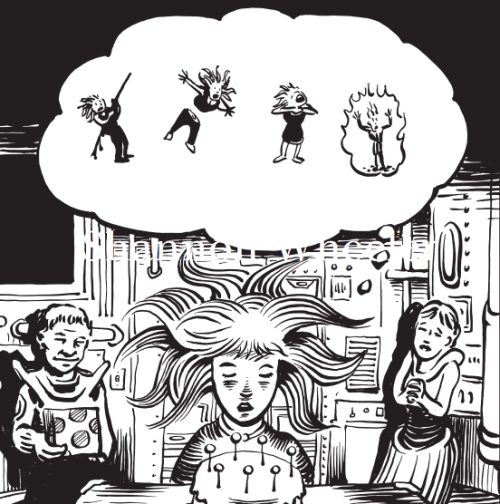
A school girl frets about what social clique her prediction will put her in.
I have to admit I avoided this story at first, because the title made me think “Sigh, comedy death.” It’s not a comedy, and that prediction has almost nothing to do with it.
Instead, it’s an incredibly focused picture of what feels like a very thoroughly imagined version of the Machine of Death world, set long after any initial shock or uncertainty about the use of the machine. Everyone’s so settled into it that schoolkids define their hang-out groups and social status by their predicted deaths; violent ones the coolest.
Something rings very true about the ease with which kids accept the morbidity of death predictions, and get more excited about the possibilities than bogged down by the fatalism. The story’s payload, to me at least, is a situation where a girl is desperately hoping for the stickiest possible end, while her father longs for something dull and distant.
She does get her prediction, but the only failing of Marshmallow is that it isn’t immediately clear what it means. That ambiguity’s a useful tool in other stories, but here I’m just not totally sure if the words are referring to something I’m not familiar with. The characters understand it, and we understand it through them, but the scene could have had more punch if it was something we could immediately grasp the implications of, to both parties.
This feels like one of the most convincing worlds, though, and the voice of the narrator is authentically young and fun.
Machine of Death: a thing that appears to be good so far. It’s now $18 whether you buy it from Amazon or Topatoco, and I think Topatoco have faster international shipping. The whole book is free in PDF form, and is trickling out steadily as an audiobook in podcast form. My story for it is online here.
Machine Of Death Is A #1 Bestseller: WTF
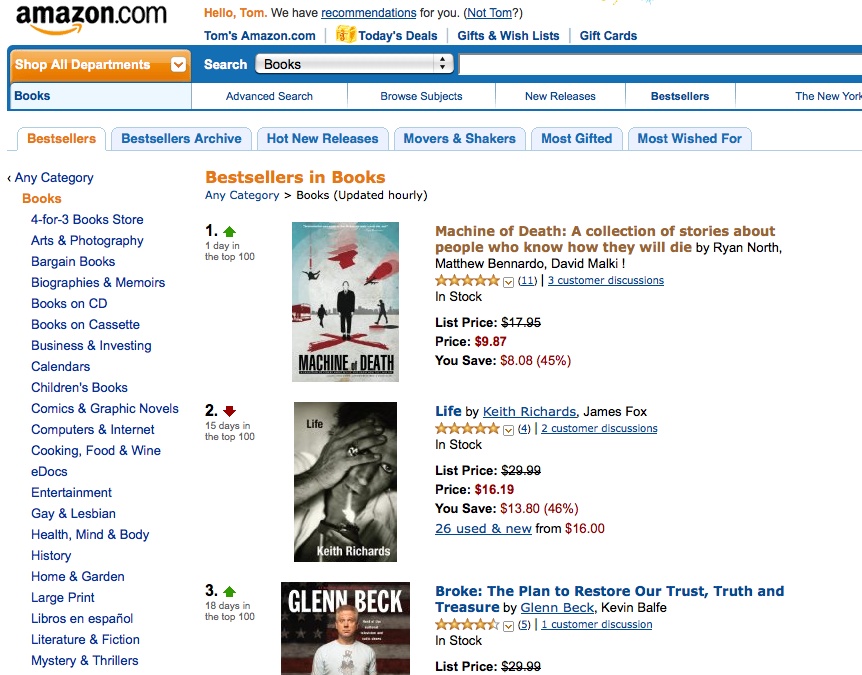
At about 7.30PM yesterday evening UK time, we finally pulled ahead of Keith Richards and became the #1 best-selling book on Amazon.com. Then we stayed there for twenty four hours. Sales were up 685,800%. We beat Glenn Beck’s new book on its launch day.
Apparently: “It was mentioned as number one on the Glenn Beck radio program this morning as an example of America’s preoccupation with death.” It was “a plea to his listeners to buy his book and not let us death-peddlers win.”
Thank you so, so much to anyone who bought it, and thanks to anyone who told other people about it. Not many people actually read the Machine of Death blog on a regular basis – not much has happened there for three years. So all this happened by people telling other people.
When the editors suggested a big push on the 26th, I thought it’d be cool, but we’d be gaming the system a bit. But really, we were just giving ourselves a launch day. We didn’t know when it would go up on Amazon.com, so we had to wait until it had before we could start organising any kind of campaign. Other books get to dictate a release date and plan around that – we did the same, we just had to rely on a little good will from people to delay until a launch day we could organise for.
Malki now has e-mails from four bookstores interested in stocking it, including Barnes & Noble, and one from the New York friggin Times. He and Ryan did a funny sort of mini-podcast to say thanks and stretch more sports metaphors.
A lot of people are asking how many copies we actually sold – I don’t have any insider info on that, but if Amazon’s percentage increase figures are right- wait, they’re not. See comments.
There’s lots more info on the PDF, audiobook, Kindle and Vulcan mindmeld editions on the official site, which’ll also have more info on if and when it’ll come to Amazon.co.uk and the like.
Thanks again everyone, particularly those in the UK who braved the shipping costs to support it. You have accomplished something amazing, annoyed Glenn Beck, and made me and a bunch of webcomic dudes very happy.
Machine Of Death Is Out: Here’s How To Get It
What is it?
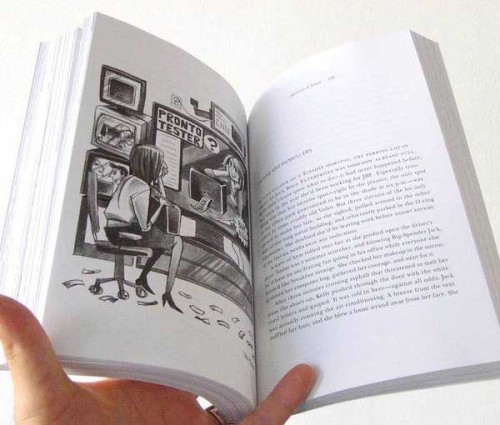
A collection of short stories all based around the idea of a machine that can tell you how you will die. The book contains 34 stories by 33 different writers, and 35 illustrations by 35 different artists. My story is about the accidental inventors of the machine, and is illustrated by Jesse Reklaw of Slow Wave, a great comic incorporating reader-submitted dreams.
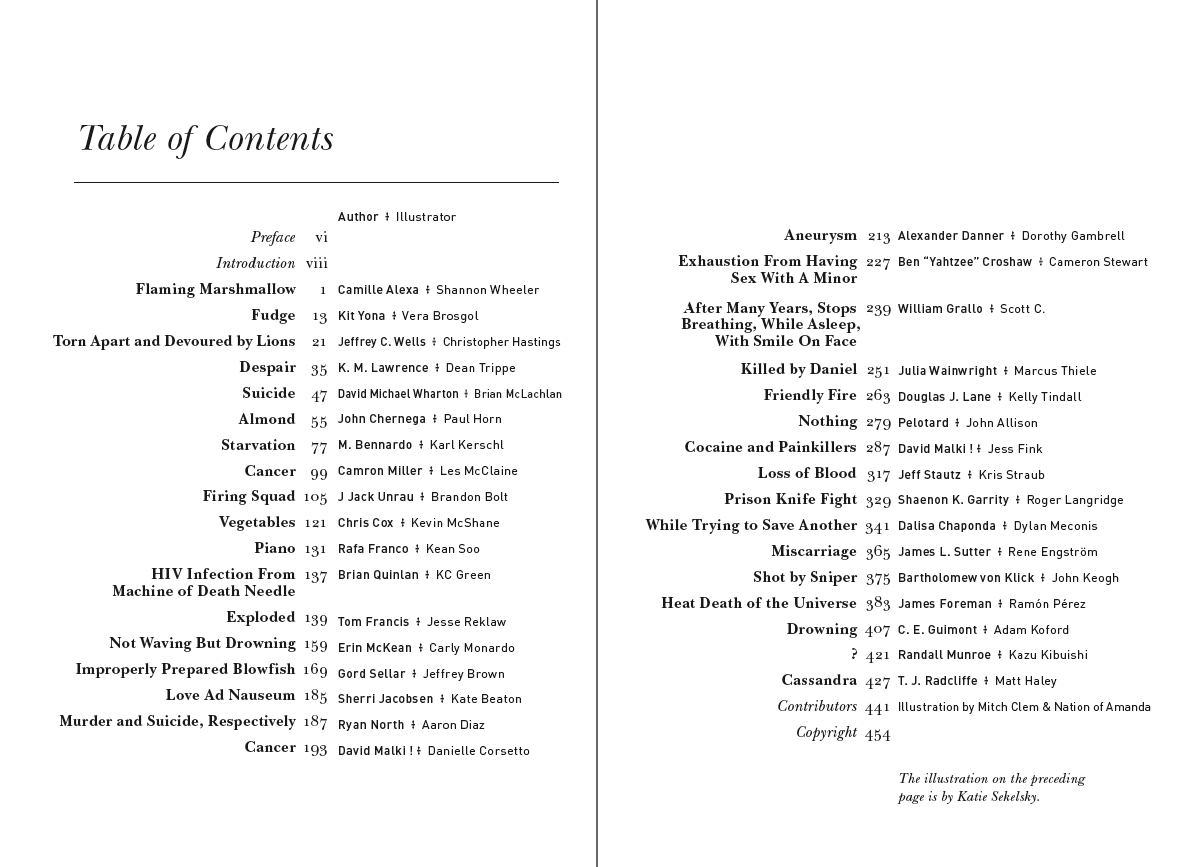
Headliners include Randall Munroe (XKCD), Yahtzee Croshaw (Zero Punctuation), Ryan North (Dinosaur Comics), John Allison (Scary Go Round), Kate Beaton (Hark! A Vagrant), Aaron Diaz (Dresden Codak), Dorothy Gambell (Cat And Girl), and Christopher Hastings (Dr McNinja). Here’s the full contents of stories and illustrators:
What’s the best way to get it?
1. Buy it on Amazon.com now. This is the best way to support the book, and the only place it’s currently available. It’s $17 in the US, or £11 plus £7 postage if you’re in the UK.
Sorry it’s a bit pricier than we’re used to in the UK – North America just generally charges more for books, and you could go for the cheapest postage option but it takes 18-32 business days. I’m not sure we have that many left on this Earth. You do get a lot of stories by cool people who aren’t me, though.
No progress yet on getting it into the UK Amazon or anywhere outside the US and Canada, so that won’t happen in the foreseeable future I’m afraid. That’s why we want to get a chart position on Amazon.com we can brag about.
If you know me in real life and live in Bath, let me know today if you want to buy a copy: it may make sense to order together this afternoon to save a little on postage.
2. From early November, I’ll be able to buy some copies wholesale and have them sent to people. This will not be significantly cheaper – about £15 with postage. But once that warehouse has them in, it’ll be quicker to send from there than from Amazon. Since that option is at least a week off, right now it’s not quicker to wait for this than to buy from Amazon, and it doesn’t support the project, so I don’t recommend it.
3. It will eventually be available as a free PDF. You won’t get the handsome physical object, but you will get to read the stories.
4. They’re working on a Kindle version too, which won’t be free. It’s not ready yet, but if you’d like to support day one sales, you can just buy the actual book on Amazon today, and forward the editors your receipt e-mail for a free Kindle version once it’s out.
5. Finally, we’ll be releasing a free audiobook of Machine of Death episodically – one story at a time as an ongoing podcast.
“Our (free) audiobook will include the voice talents of many of the authors, plus Jesse Thorn, MC Frontalot, Zach Weiner, Lore Sjöberg, Dave Kellett, Kris Straub, Colleen AF Venable, Joel Watson, and one other secret person we’re waiting to confirm. Yahtzee Croshaw reads his own story.”
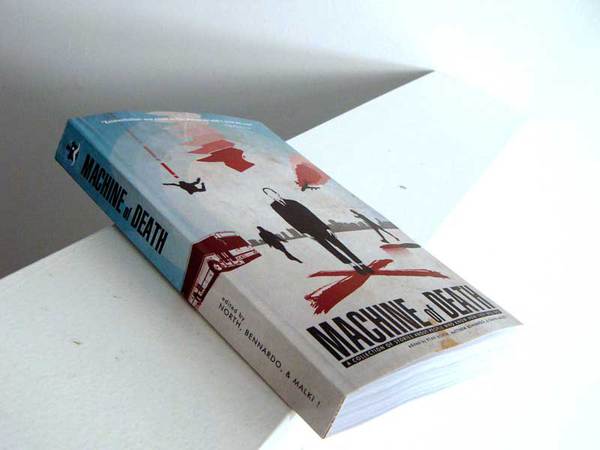
If you’d prefer one of the free methods but still want to support the project, you can still buy it on Amazon to support day-one sales, and have it shipped to Machine of Death headquarters to save on postage. Your copy will be donated to schools, libraries or showing the book off to people – equally worthy causes.
Wondermark Enterprises
Attn: MOD
2554 Lincoln Blvd #214
Venice, CA 90291
I demand a free sample
Of course. Here are the first 40 pages as a PDF:
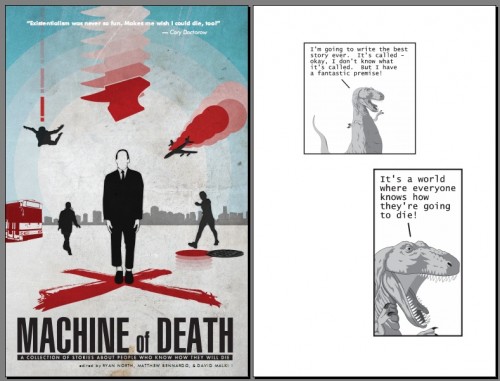
My story is still online for free. And here is the story HIV INFECTION FROM MACHINE OF DEATH NEEDLE, by Brian Quinlan, in its entirety:
I have now bought the book
Woo! Thanks! I’m actually pretty optimistic about our day one sales. I don’t get any money from the book doing well, but all proceeds go towards promoting it further, and I’d love to see it be more widely available. If you do get it, let me know in the comments. I imagine we’ll get some idea of how well it sells in general, but I’d love to hear if any came from here. I also want to say “Thanks!” a lot.
I can’t wait to read it myself – I’ve only read my own story and the one above, so I’ll be using some (most) of my contributor’s fee to buy a copy today. Randall Munroe’s – called ? – is about “what happens when physical science rejects the idea of precognition”. I am excited about this.
Machine Of Death Needs Your Help Next Tuesday
So, the short story collection I’m featured in will be out on Amazon.com in the US shortly. Woo! No confirmed UK release, but postage is about £5 for us Brits. We would particularly love for you to buy it on October 26th – next Tuesday. Here’s a truncated explanation of why, and why it’s taken so long, from editor David Malki:
But it was 2008, 2009. “The economy,” we were told. “And it’s an anthology.”
And we live on the internet enough that we knew we could sell this book.
On October 26, we want to send a message that a little project dragged kicking and screaming from “crazy idea” past “it’ll never work” all the way to “By God, they actually did it” can make a big splash. We’re internet people; you are too. We want to prove to all the people who said “this will never sell” that that’s all that matters.
Did you know that on any given day, an Amazon.com bestseller only sells a few hundred copies? Sure, they sell a hundred copies a day for weeks and months on end, but what we’ve learned is that it only takes a few hundred sales on a single day to become an Amazon.com bestseller.
We want Machine of Death to become a Number One bestseller for exactly one day. October 26.
It would be awesome if you could spread around this link, that date, and click Attend on Facebook so we can see how many people are planning to buy. I’ll post again on the day to remind people and say ‘Woo!’ again. Thanks!
Machine Of Death Is Out In Two Months
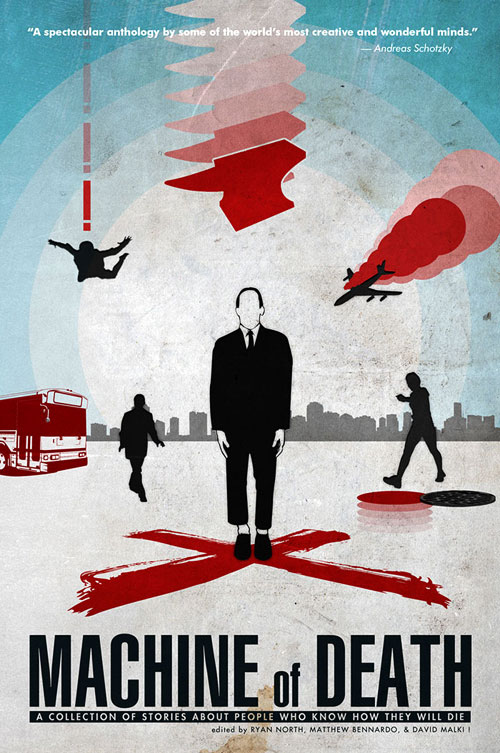
That short story collection I wrote for, Machine of Death, is actually getting published. It’s out in October, in big floppy paperback, and it’s going to be illustrated. It includes stories by:
- Randall XKCD Munroe
- Ben Zero Punctuation Croshaw (who I just interviewed)
- Ryan Dinosaur Comics North
- Tom Who’s Writing This Francis
Illustrated by people including:
- John Scary Go Round Allison
- Kate Hark! A Vagrant Beaton
- Aaron Dresden Codak Diaz
- Dorothy Cat And Girl Gambell
- Christopher Dr McNinja Hastings
I have no idea who’s illustrating mine yet, but you can’t really lose with this list. The final lineup very charitably calls my story ‘brutal, desperate and real’, so it’d be kind of hilarious to see Kate Beaton do it.
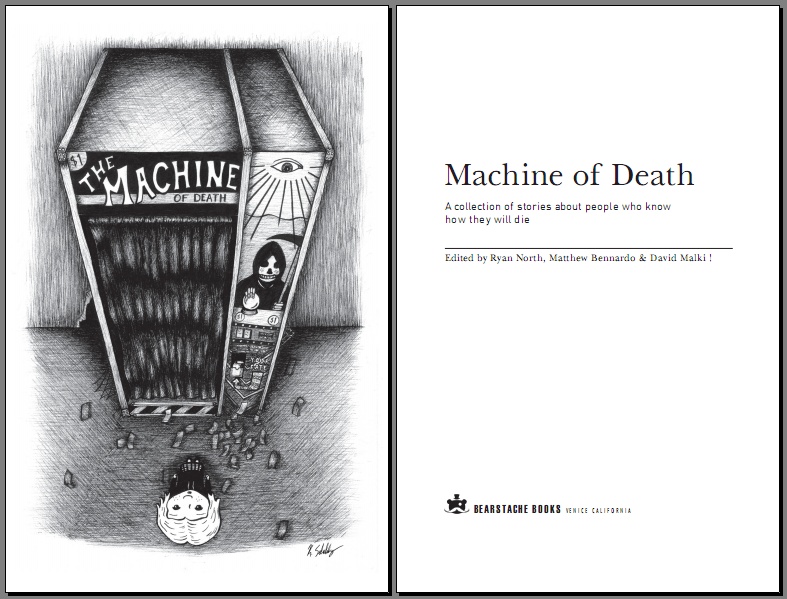
I have a flight to catch and a lot to do before and on it, so hasn’t totally sunk in yet. Here’s my story, and here’s the comic that inspired the collection. Oh yeah, and here’s the awesome cover:
The Machine Of Death Winners
The winners have been announced for that short story competition I entered a while back, for a collection of stories based around the idea of a machine that can tell you how you’re going to die. They all sound extraordinary. When the winner-notification date came and went without e-mail, I tried and failed to imagine what the winning stories were like, and the selections really show how small-minded I was being.
One of these is about paramedics in the future. One’s about a magician. There are stories about class, revolution, family, the third world, and one that’s just a series of personal ads. And one, inexplicably, is mine. They told me two or three days after I was entirely sure it had been rejected, which I can now confirm is the best way to win something.

The editors – Ryan North of Dinosaur Comics, David Malki of Wondermark and Matthew Bennardo of the world – had planned to self-publish the collection, but have apparently had some interest from actual publishing houses since. So I imagine they’re going to shop the manuscript around for a while and see if someone who could get it out to more than just Amazon.com will snap it up.
Either way the text will be free online, and eventually as an audiobook – sorry, podiobook (spit!). On my contract I waived the right to insist on reading it myself, because I couldn’t decide whether it would be more exciting to be on an audiobook in person, or to have someone good reading my thing. Instead I’m going to audition to read my own, and let them decide. If my voice really is as grave and dull as it sounds to me, hopefully they’ll tell me so and get someone else to do it. I’ve shot myself resoundingly in the foot, of course, by implying my narrator is North American.
What I didn’t know until that announcement post was that all three editors of the collection are including a story of their own. Since Ryan North basically invented a new grammatical logic for the English language in Dinosaur Comics, this is rather exciting. Inevitably his story has the best title of the lot – MURDER AND SUICIDE, RESPECTIVELY – and an immediately enticing concept: two scientists realize that the Machine may allow them to send messages backwards through time.
These three are in addition to the 29 chosen submissions, from 681 entries, so the final book with be 32 stories of something like 4,000 words each. Mine is one of the longer ones, at 6,600, and earned me the king’s ransom of $45, so I’ll be quitting my day job shortly and vacationing on the moon.
That fee is only for the First English Anthology rights, so I can still keep it online here, and will do so until the book itself is out and the whole text of that is online – when I’ll probably link to that instead. I’m imagining it’ll be something like a year before that actually happens, which sucks because I badly want to read almost all of these.
My Short Story For The Machine Of Death Collection
“Fuck!”
It came from the den. Later I’d learn that it had followed a much quieter, “Oh fuck. Oh-“
My first thought was that it had broken. I was going to spend a lot of time, over the next five years, wishing that I’d been right about that.
He burst into the room, crunching the door hinges and smacking the handle deep into the plaster. He nearly fell over trying to stop. I didn’t say anything, just stared.
“391! He was on the train this morning! He was one of the victims!” He stared too. We just stared. “Look it up!”
I didn’t have to. I didn’t have all our test cases memorised yet, but 391 I did know: EXPLODED. Continued